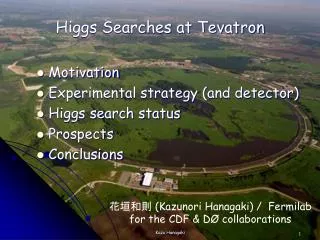
Higgs Searches at the Tevatron: Strategies, Status, and Future Prospects
310 likes | 457 Vues
This document summarizes the search for the Higgs boson at the Tevatron collider, detailing the experimental strategies implemented by the CDF and DØ collaborations. It covers the motivation behind Higgs searches linked to electroweak symmetry breaking, the experimental status of Higgs searches, and various decay channels like H → b̄b and H → WW. Additionally, it discusses the latest findings, current limitations, and future prospects regarding Higgs mass and cross-section measurements, and highlights the importance of b-jet identification techniques and background management in these high-energy physics experiments.


Higgs Searches at the Tevatron: Strategies, Status, and Future Prospects
E N D
Presentation Transcript
Higgs Searches at Tevatron • Motivation • Experimental strategy (and detector) • Higgs search status • Prospects • Conclusions 花垣和則 (Kazunori Hanagaki) / Fermilab for the CDF & DØ collaborations Kazu Hanagaki
Electroweak Symmetry Breaking • Gauge invariant no mass term • Higgs mechanism [with U(1) vector field] • L = (Dmf)*(Dmf)– V(f) - ¼ FmnFmn Dm ∂m+ieAm, Fmn ∂nAm - ∂mAn V(f) = m2f*f + |l|(f*f)2 • f is complex scalar doublet: Higgs field • e2AmAmf*fin (Dmf)*(Dmf) (e2v2)/2·AmAm mass term!! • One Higgs doublet in SM • 4 degree of freedom – 3 x (gauge boson) one Higgs boson Spontaneous symmetry breaking m2>0 (hot) potential minimum at f=0 m2<0 (cold=present world) at f0 <f> = v/sqrt(2) Kazu Hanagaki
W- W+ W- W+ g Z e- e+ e- e+ W- W+ W- W+ H n e- e+ e- e+ Why is Higgs Preferred? • Unitarity: individual diagram diverges with sqrt(s) • gauge cancellation • spin 1 intermediate state • spin 0 component due to wrong helicity state of e+e- must be canceled by spin 0 particle proportional to mass Higgs coupling! Kazu Hanagaki
Higgs Mass • MH > 114.4 GeV @95% CL search by LEP2 • MH < 175 (207) GeV @95% CL global EW fitting Higgs self-coupling diverges unstable vacuum energy scale (GeV) • Needs to be light (160-180 GeV) for a theory valid up to Plank scale • Finding a Higgs at MH ~ 120 GeV would be an evidence of new physics 115-200 GeV is our target mass range Kazu Hanagaki
If the symmetry is not broken…? • Fermion remains massless • Nucleon mass almost unchanged, but proton would be heavier than neutron • Spontaneous symmetry breaking by QCD W/Z mass ~1/2500 (W,Z vs p) very rapid inversed beta decay (pn+e++n) • Unstable proton no hydrogen atom Completely different world !! Mechanism of electroweak symmetry breaking is the mystery relevant for existence of ourselves Kazu Hanagaki
Search Strategy • MH < 135 GeV • H b b-bar dominant • too much BG in gg H b b-bar • qqW/Z+H(bb) • For high MH range • H WW dominant gg H WW • For medium MH range • W/Z+H(WW) helps Kazu Hanagaki
The Detector h = -ln[tan(q/2)] Kazu Hanagaki
Silicon Tracker for b-jets Identification • New silicon detector in DØ for improvement of b-jet ID • installed and tested in this shutdown period Silicon micro-strip detector for precise measurement of charged particle trajectory Kazu Hanagaki
Identification of b-jets • ctb-hadron ~ 400-500 mm travel by a few mm from primary vertex • S(Lxy) = Lxy/s(Lxy) or S(IP) = d0/sd0with V0 (Ks etc.) removal secondary vertex Lxy primary vertex DØ sec.vertex base d0 CDF Kazu Hanagaki
Higgs Search Status Standard Model MSSM
q H W*/Z* q(’) W/Z Standard Model – Low Mass Higgs b • sxBr(W/Zff) = 0.015-0.003 pb • Backgrounds • W/Z+bb/cc/jj, top, W/Z+Z(bb), QCD… • b-jet ID, jet energy resolution are important • W/Z identification • Wln: high pT isolated lepton + missing ET W mass • Znn: large missing ET • Zll: high pT isolated dilepton Z mass • High pT dijets with b-ID dijet mass b f f Z(nn)H(bb) Lint = 261 pb-1 Kazu Hanagaki
W(ln)H(bb) • pT(e or m) > 20 GeV • Missing ET > 20 GeV (CDF) > 25 GeV (DØ) • CDF: jet ET>15 GeV, |h|<2 • DØ: jet ET>20 GeV, |h|<2.5 • b-jet tagging • Consistent with SM background expectations • backgrounds well understood Kazu Hanagaki
e+ n W+ n W- e- Standard Model – High Mass • Two isolated high pT leptons + missing ET • Dominant background is qqWW • different decay angular correlation with Higgs signal DØ Run II Preliminary Lint = 950 pb-1 Kazu Hanagaki
The Other Analyses • WH(WW) l±nl±nX • high pT isolated like sign dilepton (ee,mm,em) • large missing ET • diboson production is the main background due to charge mis-identification • t(bW)t(bW)H(bb) • exactly one e or m • missing ET • 5 or more jets • 3 or more b-jets Kazu Hanagaki
Standard Model Higgs Summary ~15 • First DØ combined result • Z(ll)H not yet included Kazu Hanagaki
0 0 t b MSSM Higgs • Two Higgs doublet in MSSM to avoid anomaly • 8 degrees of freedom – 3 x (longitudinal polarization of W± and Z) 5 scalars (h, H, A, H±) • tanb = <Hu>/<Hd> • At high tanb, s(h or H, A) is enhanced • Br(Abb)~90%, Br(Att)~10% f0 b + 0 b Amplitude tan Amplitude 1/tan Amplitude tan Kazu Hanagaki
MSSM Higgs Search Status • CDF: f0tt; DØ: b(b)f0b(b)bb, f0tt Kazu Hanagaki
200E30 100E30 Luminosity • Improvement by the recycler as a storage ring of p-bar • Electron cooling at the recycler • 4-8 fb-1 by 2009 Kazu Hanagaki
Improvement of b-tag at DØ correlation coefficient QCD data (fake rate) • Three b-tag algorithms in DØ; SVT, JLIP, and CSIP • correlated in efficiency • small correlation for fake significant improvement by combination by Neural Network (~30% per jet) m+ jet data (efficiency) SVT JLIP CSIP SVT JLIP CSIP SVT JLIP CSIP SVT JLIP CSIP Kazu Hanagaki
The Future of SM Higgs Search • Comparison w.r.t. old sensitivity study • For MH=115GeV: Limit/s =15 @~330pb-1by DØ alone vs 95% CL exclusion @2fb-1 • We can reach very close to the sensitivity study Kazu Hanagaki
Conclusions • Mechanism of electroweak symmetry breaking is a profound mystery • Searches have been carried out with 194-950 pb-1 of data • Remaining events consistent with SM backgrounds • If the (SM) Higgs exists and is light, there is a great potential to find the Higgs Now is the Time to Search for Higgs at Tevatron Kazu Hanagaki
Projection of MSSM Higgs Search • Tevatron will probe below Kazu Hanagaki
A h H MSSM Parameters radiative correction depending on many parameters Kazu Hanagaki
New Technique of Jet Reconstruction • Charged track information in jet reconstruction • Ecal = E(e/g) + E(neutral hadron) + E(chrgd had) • Etrkcal = Ecal – Eexpect(chrgd had) + Etrk(chrgd had) resolution measured in g+jet data DØ Run II Preliminary similar improvement at CDF as well Kazu Hanagaki
b-tag efficiency measurement at DØ • Solve 8 equations for 8 unknowns example to measure JLIP efficiency with the combination of muon tag m+jet m+jet && opposite tag before b-tag b-tag by muon unknowns b-tag by tagger under testing b-tag by both tagger number of events Kazu Hanagaki
Low Mass Higgs Search at DØ • W(e/m+n)H(bb): sxBR = 0.015 pb • Z(ee/mm)H(bb): sxBR = 0.003 pb • Z(nn)H(bb): sxBR = 0.015 pb Kazu Hanagaki