Comets
Comets are small, icy bodies originating from the Solar System, often described as "dirty snowballs." They are remnants from the early solar nebula, orbiting the Sun in elliptical paths. When near the Sun, comets vaporize, creating long tails that point away due to solar radiation pressure. This article delves into the ingredients that compose a comet, their orbits, notable comets like Halley and Hale-Bopp, and the differences between meteors and meteorites. Explore the wonders of these celestial objects, including their connections to the Oort Cloud and Kuiper Belt.

Comets
E N D
Presentation Transcript
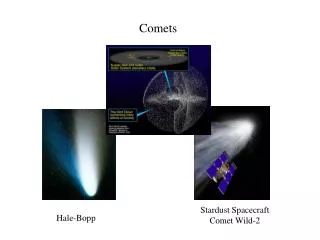
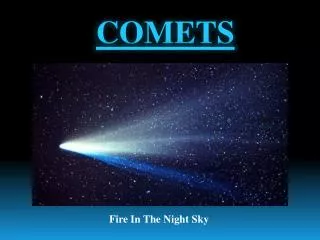
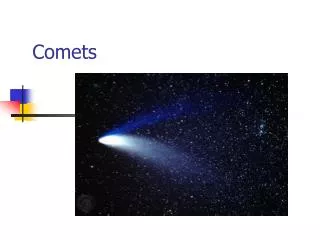
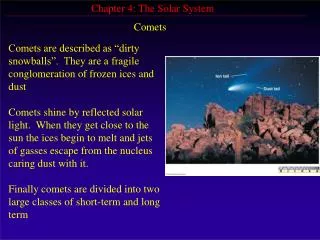
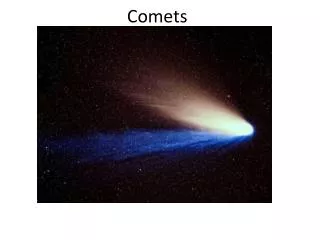
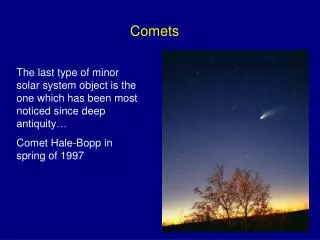
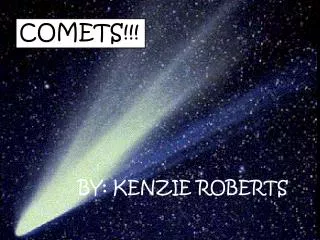
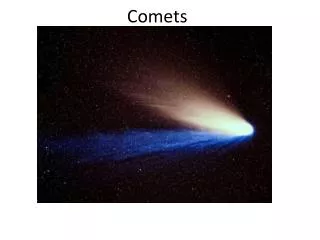
Comets • Small dusty/icy chunk of material few kms size (often characterized as “dirty snowball”) • Originally condensed out of Solar nebula and still orbit Sun - primitive material • Orbits often elliptical, large aphelion • Partially vaporized when close to Sun - material (gases) then pushed by sunlight makes long tail • Gas tail always points away from Sun • Also dust tail along orbit
Pushed by Sun Dust along comet’s orbit PARTS of a COMET
Dust trail Dust trail Ion trail Ion trail Comet Hale-bop COMET TAIL ORIENTATION
About the mass of Mt. Baker RECIPE for a COMET • Ingredients • Frozen methane • Frozen water • Frozen ammonia • Dust grains (dirt) • Traces of organic compounds and other chemicals • Directions • Mix into a ball about 10 km across containing 100,000,000,000,000, (1014) kg of this mixture
1986 COMET HALLEY’S PATH 1910 and 1986 1910
ORIGIN of LONG PERIOD COMETS • Originate in Oort Cloud • a huge reservoir • ancient Solar System • material far from Sun • likely produced by • planetesimals ejected • by Jupiter and Saturn • Early on from inner • Solar System. • Passing star perturbes • Cloud sends lumps • inward - see as comets • when near Sun.
KUIPER BELTPlanetesimals ejected from inner Solar System by stronggravitational fields of Giant Planets - some interact Jupiter and Saturn flung far out to Oort Cloud, interactions Uranus and Neptune pushed them out to Kuiper Belt Kuiper Belt
KUIPER BELT OBJECTS Pluto + 3 Moons Sedna e =0.86 Perihelion 76 AU Aphelion 975 AU! P =12,000 years
METEORS AND METEORITES Meteors are parts of comets that pass through Earth’s orbit - burn up in Earth’s atmosphere Meteorites are ground up pieces of asteroids - off orbit - enter Earth’s atmosphere and survive passage
Meteor Shower Comet breakup near perihelion Material spread out along orbit If Earth passes through comet debris - shower
A METEOR STORM Leonid Shower 1833 Wood Cut
ANTARCTIC METEORITE Easiest to find meteorites against snow. Most found in Arctic or Antarctic Primitive material - planetesimals - useful for dating Solar System Many varieties - stony, metallic, often contain organic material