Dilation and Scalar Multiplication of Quadrilateral KLMN with Center at the Origin
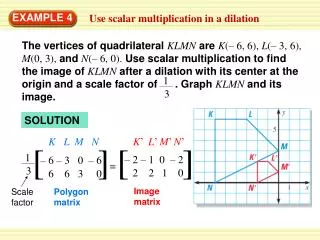
This guide provides a step-by-step process to find the image of quadrilateral KLMN after a dilation centered at the origin with a specific scale factor using scalar multiplication. The vertices of KLMN are K(–6, 6), L(–3, 6), M(0, 3), and N(–6, 0). By applying the scalar multiplication, you can determine the new coordinates of the dilated image K′L′M′N′. Additionally, the guide illustrates how to graph both the pre-image and its image for clear visualization of the transformation process.

Dilation and Scalar Multiplication of Quadrilateral KLMN with Center at the Origin
E N D
Presentation Transcript
The vertices of quadrilateral KLMNare K(– 6, 6), L(– 3,6), M(0, 3), and N(– 6, 0). Use scalar multiplication to find the image of KLMNafter a dilation with its center at the origin and a scale factor of . Graph KLMNand its image. K L M N K’ L’ M’ N’ [ ] [ ] – 2 – 1 0 – 2 2 2 1 0 = 1 1 3 3 Image matrix Scale factor Polygon matrix – 6 – 3 0 – 6 6 6 3 0 EXAMPLE 4 Use scalar multiplication in a dilation SOLUTION
The vertices of ABCare A(– 4, 1),B(– 2, 2), and C( – 2,1). Find the image of ABCafter the given composition. Translation: (x, y) (x + 5, y + 1) Dilation: centered at the origin with a scale factor of 2 STEP 1 Graph the preimage ABCon the coordinate plane. EXAMPLE 5 Find the image of a composition SOLUTION
STEP 2 Translate ABC5 units to the right and 1 unit up. Label it A’B’C’. STEP 3 Dilate A’B’C’using the origin as the center and a scale factor of 2 to find A”B”C”. EXAMPLE 5 Find the image of a composition
5. The vertices of RSTare R(1, 2), S(2, 1), and T(2, 2). Use scalar multiplication to find the vertices of R’S’T’ after a dilation with its center at the origin and a scale factor of 2. ANSWER R’(2,4), S’(4,2), T’(4,4) for Examples 4 and 5 GUIDED PRACTICE
6. A segment has the endpoints C( –1, 1) and D(1, 1). Find the image of CDafter a 90° rotation about the origin followed by a dilation with its center at the origin and a scale factor of 2. ANSWER C’( 2, 2), D’( 2,2) for Examples 4 and 5 GUIDED PRACTICE