Textbook Information Provisioning (TIP)
The Textbook Information Provisioning (TIP) project aims to simplify textbook recommendations for faculty and enhance access to textbook information for students. This initiative involves creating a streamlined process with built-in defaults, enabling timely access to textbook data for informed purchasing decisions. By utilizing existing technology and ensuring compliance with the HEOA Act, the project seeks to improve the current systems, offering cost savings, easier access, and improved data validation. Key steps include development and piloting by mid-2010, along with continued collaboration across stakeholders.

Textbook Information Provisioning (TIP)
E N D
Presentation Transcript
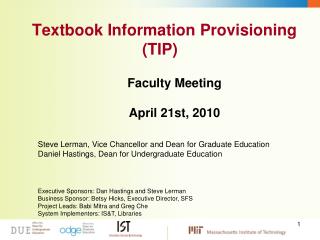
Textbook Information Provisioning(TIP) Faculty Meeting April 21st, 2010 Steve Lerman, Vice Chancellor and Dean for Graduate Education Daniel Hastings, Dean for Undergraduate Education Executive Sponsors: Dan Hastings and Steve Lerman Business Sponsor: Betsy Hicks, Executive Director, SFS Project Leads: Babi Mitra and Greg Che System Implementers: IS&T, Libraries
Guiding Principles • --- Textbook Information Provisioning project • For faculty: recommending textbooks • Will be as simple and seamless with as many built-in defaults as possible. • Will require minimal action • Will require faculty to act affirmatively to change the default data. • For students: buying textbooks • Students need to get timely access to information about textbooks so that they can make informed purchase decisions. • For the TIP project team :implement it within stated deadlines (June,2010) and comply with HEOA (2008) Act • build on existing technology and processes to the extent possible
Current Process --- Textbook Information • Textbook information is submitted to both the COOP and the Libraries using different forms, emails, telephone calls, spreadsheets, etc. • Process varies across departments. • Students retrieve textbook information via Stellar, Coursepicker, Bookpicker and other sources. • About 27% of the subjects have textbook information in Stellar/the Library system.
New Process---Textbook Information • Creatingone new MIT form --- data will be used by MIT and the COOP. • Leveraging the existing Online Textbook Information (OTI) service and Stellar • Making textbook information accessible via the online Subject Listing & Schedule(Registrar’s Office) • New process: Form Data WarehouseISBN/Purchase Price ValidationOTIOnline Subject Listing & Schedule .
Benefits • For Students • Cost savings > more time to shop around • No learning curve > will use existing systems • Ease of access > more info on subjects available at one location • For Faculty • Simpler process > One form • Aggregation > New form also allows for entering info on supplementary reading, CDs, media, texts • For the Institute • Compliance with the HEOA (2008) Act
Challenges • Bridging the reality between • When faculty ordinarily decide to recommend required textbooks, and • How much in advance students need to get that information in order to get the ‘best’ deal possible • Timeliness of data entry of textbook information • Student access to key data by pre-reg date ---ISBN, publisher’s price, title, author, version • Validation of textbook information • Communications effort • Best way to partner with the COOP
Next steps • By end-April, 2010 --- Development of the technical solution • May, 2010 --- Piloting the solution • June 15th, 2010 --- Implementing the production version of the solution • Communicating the approach and solution • An article in the May/Jun 2010 issue of the Faculty Newsletter • Continuing discussions with faculty, students, staff, CUP, CGP, UA, GSC, Graduate and Undergraduate Administrators, Education Officers, Senior Leadership
Questions?Textbook Information ProvisioningFor further information, please contact: • tip-project@mit.edu • Babi Mitra, babi@mit.edu • Greg Che, gche@mit.edu