Understanding Intermolecular Forces and States of Matter
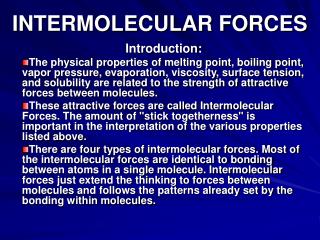
This text explores the fundamental concepts of intermolecular forces and their relation to the states of matter, focusing on solids, liquids, and gases. It explains how solids are characterized by strong intermolecular forces that must be overcome to melt into liquids. As a substance is heated, these forces weaken, allowing the liquid to transition into a gas. The process can be reversed when cooling occurs. The description also includes the types of intermolecular forces such as London dispersion forces, highlighting their significance in molecular interactions.

Understanding Intermolecular Forces and States of Matter
E N D
Presentation Transcript
Intermolecular Forces
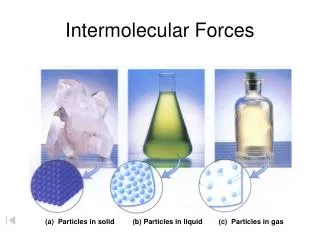
What state of matter is represented by these particles? Solids
In order to melt this solid the forces of attraction between these particles must be overcome.
In order to melt this solid the forces of attraction between these particles must be overcome.
In order to melt this solid the forces of attraction between these particles must be overcome.
In order to melt this solid the forces of attraction between these particles must be overcome.
The forces between these liquid particles are weaker now since the particles are further apart
The forces between these liquid particles are weaker now since the particles are further apart
If the substance is heated further the liquid can turn into a gas
If the substance is heated further the liquid can turn into a gas
If the substance is heated further the liquid can turn into a gas
If the substance is heated further the liquid can turn into a gas
If the substance is cooled the gas will turn back into a liquid
If the substance is cooled the gas will turn back into a liquid
the energy required to overcome these forces of attraction determine the substance’s melting point.
Types of Intermolecular Forces Between Molecules London Dispersion Forces – very weak attractive forces between all molecules
Types of Intermolecular Forces Between Molecules London Dispersion Forces – only important between non-polar molecules nonpolar nonpolar nonpolar nonpolar nonpolar nonpolar nonpolar nonpolar nonpolar nonpolar nonpolar nonpolar