NTC ACTIVITIES 2005 Outline
This document outlines significant joint activities between NTC and MIT in 2005, focusing on the development and demonstration of autonomous aircraft systems. Key highlights include the ONR STTR Phase II final demonstration featuring multi-vehicle cooperation in urban environments, robust autonomous rotorcraft, and the AFOSR STTR project addressing challenges of intermittent communication. The X-Series helicopter development introduced new technologies for aerial photography and surveillance applications, while ongoing research emphasizes autonomy, vision systems, and HIL simulation for enhanced navigation and safety.

NTC ACTIVITIES 2005 Outline
E N D
Presentation Transcript
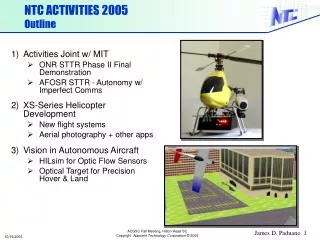
NTC ACTIVITIES 2005Outline • Activities Joint w/ MIT • ONR STTR Phase II Final Demonstration • AFOSR STTR - Autonomy w/ Imperfect Comms • XS-Series Helicopter Development • New flight systems • Aerial photography + other apps • Vision in Autonomous Aircraft • HILsim for Optic Flow Sensors • Optical Target for Precision Hover & Land
1) JOINT MIT / NTC ACTIVITIES Aeronautics & Astronautics • ONR STTR: Multi-vehicle cooperation in urban environment • Final Demonstration: 2-vehicle beyond line-of-sight recon • 2 fully autonomous rotorcraft • Real-time coordination by MILP • ‘Away’ UAV goes beyond line-of-sight • ‘Relay’ UAV maintains LOS w/ ‘Away’ UAV and ground station Flight Data in ‘Suburban’ Terrain: Red=Away, Green=Relay • AFOSR STTR: CSAT with Intermittent Communication • Capabilities being developed • Robust Distributed Task Assignment • Comm. emulation for multi-vehicle HILsim and flight testing • Communication Health Management • Low-cost on-board planning module • Phase II Testbed: MIT Fixed-Wing Fleet RDTA Concept (How, MIT)
2) XS-Series Helicopter Development • New airframe, alternator, & 60W UPS • Gas power, comms ~5 mile range • Lighter weight avionics & suspension • Mount points for cameras & sensors • New ground operator console/moving map • Automatic take-off, landing, waypoint navigation, and real-time path uplink (for centralized coordination) • Fail-safe and reversion modes NEAR-TERM APPLICATIONS • Aerial photography/videography: • Stable, hovering platform • Higher altitudes than feasible manually • More accurate altitude, heading • Testbed: Open architecture for integration of additional sensors • “VTUAV surrogate” • < 25 lbs: Lower cost, risk • 2 x 0.7 GHz Pentium processors on board for testing autonomy, vision, etc.
3) Vision in Autonomous Aircraft Aeronautics & Astronautics • Optic Flow Sensor Testing (DARPA) • Sensor from Centeye Inc. • HILsim environment with urban terrain • Feasibility of See-and-Avoid Using Optic Flow • 2nd ‘Threat’ Vehicle Simulated in HILsim environment • Detection, avoidance tests conducted • Algorithms for Dodging / Urban Nav • Optical Target for Precision Landing • Patented design using Moire patterns • Prelim. development underway at MIT • Next phase beginning at NTC • Features • Position/orientation relative to target derived using passive imagery • Position sensitivity ~1 cm • Low resolution imagery sufficient to deduce relative position