Understanding Ejection Flows and Accretion in AGNs: Insights from Simbol-X
This report discusses key issues in the study of Active Galactic Nuclei (AGNs), focusing on the characterization of accretion flows and outflows around supermassive black holes. It highlights the particle content, geometry, and velocity of jets and winds, along with their impact on host galaxies and clusters. Open problems include disentangling heavy absorption versus blurred reflection and understanding the roles of thermal versus non-thermal emissions in radio-loud sources. The report emphasizes the necessity of broad-band spectral data for advancing black hole astrophysics.

Understanding Ejection Flows and Accretion in AGNs: Insights from Simbol-X
E N D
Presentation Transcript
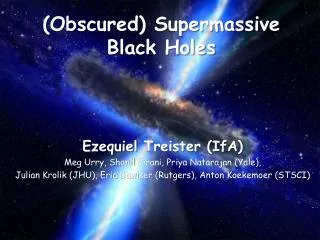
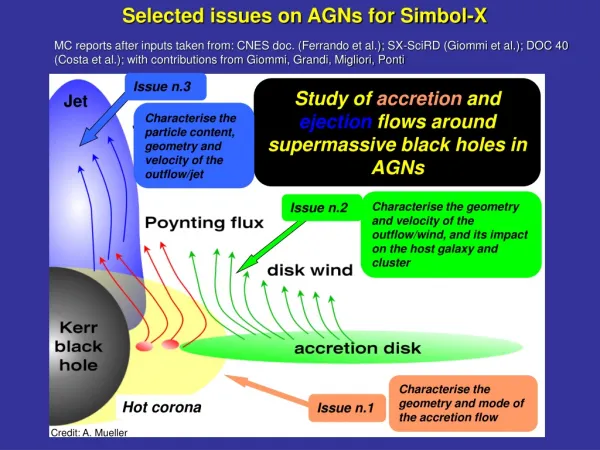
MC reports after inputs taken from: CNES doc. (Ferrando et al.); SX-SciRD (Giommi et al.); DOC 40 (Costa et al.); with contributions from Giommi, Grandi, Migliori, Ponti Selected issues on AGNs for Simbol-X Issue n.3 Study ofaccretionand ejectionflows around supermassive black holes in AGNs Jet Characterise the particle content, geometry and velocity of the outflow/jet Characterise the geometry and velocity of the outflow/wind, and its impact on the host galaxy and cluster Issue n.2 Characterise the geometry and mode of the accretion flow Hot corona Issue n.1 Credit: A. Mueller
Goal:Characterise the geometry and mode of accretion flow Open Problems: disentangle (heavy) absorption vs (blurred) reflection in RQs, and thermal vs. non-thermal in RLs (Key) Requirement:Broad-band (0.1-100 keV) spectra Impact on:BH astrophysics Issue n.1 Goal:Characterise the geometry and velocity of the outflow/wind, and its impact on the host galaxy and cluster Open Problems: confirm massive warm-absorbers in RQs, and non-thermal mapping in radio-lobes/hot-spots (Key) Requirement:Hard (2-20 keV) spectra + imaging Impact on:BH-galaxy and BH-cluster co-evolution Issue n.2 Goal:Characterise the particle content, geometry and velocity of the outflow Open Problems: confirm high-velocity, massive, & variable warm absorbers in RQs, and SSC vs SEC in RLs (Key) Requirement:Hard (2-20 keV) spectra + Broad-band spectra Impact on:Jet formation, acceleration physics, and cosmic backgrounds Issue n.3
Goal:Characterise the geometry and mode of accretion flow Open Problems: disentangle (heavy) absorption vs (blurred) reflection in RQs, and thermal vs. non-thermal in RLs (Key) Requirement:Broad-band (0.1-100 keV) spectra Impact on:BH astrophysics Issue n.1 Q: Heavy absorber or blurred relativistic reflection? …This is the question… A: Hard X-ray spectra Simbol-X simulations To Be Done Reflection Absorption NLSy1: 1H0707-495 (Fabian et al. 2003;Tanaka et al. 2004)
Goal:Characterise the geometry and mode of accretion flow Open Prolems: disentangle (heavy) absorption vs (blurred) reflection in RQs, and thermal vs. non-thermal in RLs (Key) Requirement:Broad-band (0.1-100 keV) spectra Impact on:BH astrophysics Issue n.1 Q: Thermal or non-thermal? A: Broad-band spectra Simbol-X simulations To Be Done 3C273: Grandi & Palumbo 2004, Science
Goal:Characterise the geometry and velocity of the outflow/wind, and its impact on the host galaxy and cluster Open Problems: confirm massive warm-absorbers in RQs, and non-thermal mapping in radio-lobes/hot-spots (Key) Requirement:Hard (2-20 keV) spectra + imaging Impact on:BH-galaxy and BH-cluster co-evolution Issue n.2 Q: Massive high-velocity absorbers? PG1211+143 A: Highest possible throughput between 2-20 keV 2 Energy (keV) 5 7 10 Simbol-X simulation PDS456 2 Energy (keV) 5 7 10 Pounds et al. 2003,Reeves et al. 2003
Goal:Characterise the geometry and velocity of the outflow/wind, and its impact on the host galaxy and cluster Open Problems: confirm massive warm-absorbers in RQs, and non-thermal mapping in radio-lobes/hot-spots (Key) Requirement:Hard (2-20 keV) spectra + imaging Impact on:BH-galaxy and BH-cluster co-evolution Issue n.2 Pictor A: Grandi, Migliori et al., in prep Q: Where/how is non-thermal emission in RGs and clusters? A: Detailed Imaging at high energies Simulated Images (TBD) Perseus Cluster: Fabian et al. 2006
Goal:Characterise the particle content and geometry and velocity of the outflow Open Problems: confirm high-velocity, massive, & variable warm absorbers in RQs, and SSC vs SEC in RLs (Key) Requirement:Hard (2-20 keV) spectra + Broad-band spectra Impact on:Jet formation, acceleration physics, and cosmic backgrounds Issue n.3 Seyfert Gal NGC1365: Risaliti et al., 2005 Q: Massive and variable absorber? A: Highest possible throughput between 2-20 keV Simbol-X simulation
Goal:Characterise the particle content, geometry and velocity of the outflow Open Problems: confirm high-velocity, massive, & variable warm absorbers in RQs, and SSC vs SEC in RLs (Key) Requirement:Hard (2-20 keV) spectra + Broad-band spectra Impact on:Jet formation, acceleration physics, and cosmic backgrounds Issue n.3 Q: SSC vs. SEC? A: Broad-band spectra (SED+flare behaviour) Giommi et al. 2006 Simulated spectra (TBD?)b
Summary of key requirements TO BE QUANTIFIED!! Issue n.3 Study ofaccretionand ejectionflows around supermassive black holes in AGNs Broad-band spectra and SEDs Broad-band spectra and images Issue n.2 Broad-band Spectra Hot corona Issue n.1 Credit: A. Muller
A proposal for discussion: Motivations of this proposal are to: - Keep ALL community involved - Keep scientific case up to date, and open to unkown ideas
Effective areas Different designs Effective areas Comparison (in soft band)
Background models Background spectra
Issue 2: Heavy absorption or blurred reflection? Simulations Edges and absorption lines at E~7.1-9.0 keV (rest-frame) + vout~ 0.1-0.5c Eobserved~ 8-14 keV !! High energies are a MUST HAVE to detect and characterise highest velocity outflows!! (N.B: highest velocities = highest mass/kinetic energy)
Issue 3: Characterisation of warm, high-v, and massive outflows Simulations Model: PL + 2 emission lines + 4 abs. lines Model with narrow emission and absorption lines: PL (Г=1.9, F(2-10)=10-11erg/cm2s, Exp.=50 ks) + 2 FeK emission lines (E1=5 keV, E2=6.4 keV, σ1= σ2=50 eV, EW1=EW2=100eV) + 4 FeK absorption lines (E1,2,3,4=7, 9, 12, 15 keV, σ1,2,3,4<50 eV, EW1,2,3,4=-100eV) Edges and absorption lines at E~7.1-9.0 keV (rest-frame) + vout~ 0.1-0.5c Eobserved~ 8-14 keV !! Acceleration Deceleration Eabs<100 eV Idee would be to follow the evolution of blob ejections (or injections) N.B: Masses involved can be greater than Mearth (1027g/ejecta) >>10-11g in accelerators
Issue 1: FeK lines, continuum reflection and High-E cut-off Model: Simulations Broad band capabilities are a MUST to characterise the reflection component and associated FeK line