Understanding Nuclear Changes: Fundamental Concepts and Key Figures in Nuclear Physics
This review covers essential concepts of nuclear changes, including nuclear decay processes, types of radiation, and the significance of half-life in radioisotopes. Learn about particles emitted during decay, such as alpha and beta particles, and explore fundamental questions regarding energy production in fission reactions. The review also highlights prominent physicists, including those who contributed to the theory of relativity and nuclear chain reactions. This guide serves as a comprehensive overview for anyone interested in nuclear physics and radioactivity.

Understanding Nuclear Changes: Fundamental Concepts and Key Figures in Nuclear Physics
E N D
Presentation Transcript
Chapter 10 Nuclear Changes REVIEW
1. What is the process in which an unstable atomic nucleus emits charged particles or energy or both? 2. What type of nuclear decay releases energy but not a particle? 3. True or False: All natural radiation is at a level low enough to be safe. 4. What is the half-life of any radioisotope? 5. Which of the following particles is smaller than the rest? a. Electron c. neutron b. Proton d. alpha particle
6. During nuclear fission, great amounts of energy are produced from what? 7. What is an ALPHA particle? 8. What is a BETA particle? 9. What goes in the box and what type of decay? 10. What goes in the box and what type of decay?
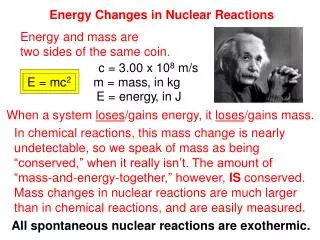
11. What is the half-life of a substance if after 100 years, ¼ is undecayed and ¾ has decayed to the new substance? 12. A 64 gram sample of I-131 is tested after 40 days and is found to contain only 2 grams of I-131. What is the half life of I-131? 13. Who developed the theory of special relativity ( E=mc2)? 14. Who made radium available; Radioactivity?
15. Who is responsible for the 1st self-contained nuclear chain reaction? 16. Who was noted for his work with fission? 17. Who developed the Law of conservation of mass? 18. Who was the lady Austrian physicist who related fission to E=mc2