A Tale of Two Empires
70 likes | 235 Vues
This article explores the rich-poor gap through the lens of ancient Rome and contemporary America. It begins with Rome's expansion after the Punic Wars and the resulting disparities championed by politicians like Tiberius and Gaius Gracchus, who sought to bridge this divide through welfare initiatives. In contrast, post-World War II America saw efforts like the GI Bill promoting middle-class growth. However, recent trends indicate a widening wealth gap reminiscent of Rome's decline. Can America learn from history to avoid the pitfalls of neglecting the poor?


A Tale of Two Empires
E N D
Presentation Transcript
A Tale of Two Empires The Rich/Poor Gap
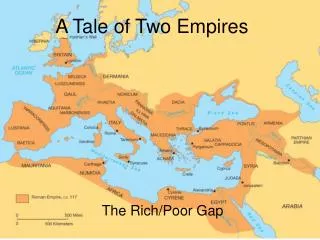
Rome’s Beginning The Rich poor gap first began its growth at the start of the Roman Empire Through the Roman victory in the Punic wars Rome gained land which went to the leaders, Aristocrats etc..
The Gracchus brothers Rome’s first reformers were Tiberius and Gaius Grachus They were the 1st to try and close the Rich poor gap Together they created a form of wellfare by offering land and grain to the poor
U.S. Reforms Welfare GI Bill Under F.D.R a piece of legislation was passed that gave those in the military a chance at higher learning. This helped create the largest middle class in U.S. history By the 1920s the U.S. was just one of the many countries with welfare. This welfare supports the poor potentially decreasing the rich poor gap further.
United States Rapid Growth In 2005 both the top 1% and top 10% saw increases of about 9%, while the bottom 90% saw a drop of about 0.6% As a collective body the top 300,000 make roughly as much as the other 150 million
U.S. & Rome Will United States follow Rome’s foot steps? Rome essentially abandoned the poor. They then took the “spoils” of war and kept them for the upper class The United States is still focused on the rich poor gap, and trying to reduce it. An example: Forcing AIG and other to return their money. This abandonment led to revolt, lack of patriotism, etc…
Sources • Ellis, Elisabeth & Esler, Anthony. World History Connections to Today. Upper Saddle River: Prentice-Hall, 1997. • Johnston, David. "The gap between rich and poor grows in the United States.." International Herald Tribune The Global Edition of The New York Times March 29, 2007. . March 24, 2009 <http://www.iht.com/articles/2007/03/29/business/income.4.php>. • http://www.gibill.va.gov/ http://www.the-romans.co.uk/gallery2/full/republic10.jpg http://worldmapsonline.com/UnivHist/30287_6.gif