Download
1 / 16
160 likes | 272 Vues
Concussions are serious brain injuries that can occur in any sport, often due to impact forces. High-contact sports such as football, soccer, and wrestling are particularly at risk. Parents should be aware of the signs and symptoms, which can range from cognitive confusion to physical discomfort and emotional changes. Cognitive testing helps assess recovery, but ensuring proper management of an athlete's physical and mental health is vital. This guide emphasizes the importance of recognizing concussions, understanding recovery times, and seeking medical advice to ensure safe sports participation.

E N D
Definition • International experts: • “a complex pathophysiological process affecting the brain, induced by traumatic biomechanical forces -- either a direct blow to the head, face or neck; or a blow elsewhere on the body with an ‘‘impulsive’’ force transmitted to the head.” • A concussion is a brain injury caused by traumatic force
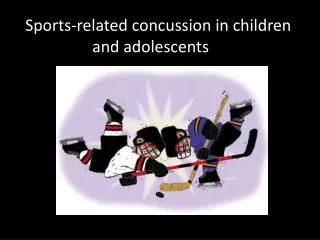
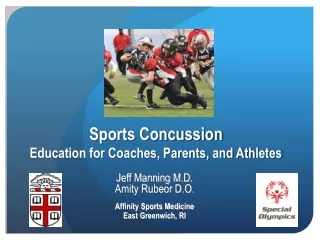
Which Sports? • Concussions can occur in any sport – contact with players, equipment, or facilities • Most common at the high school level: • Football • Boys & Girls Soccer • Lacrosse • Wrestling • Basketball • “Honorable Mentions” • Cheerleading, Baseball, Ice Hockey
Concussion Signs & Symptoms • Cognitive - Amnesia, confusion, disorientation • Physical - Balance difficulty, vertigo, tinnitus, blurry vision, nausea • Emotional - Change in mood, anxiety, depression, agitation
Common Signs and Symptoms May not develop until minutes, hours, or days after injury • Athlete Complaints • Headaches • Dazed feeling, not right, bell ringing, "out of it” • Blurry vision • Dizziness, unsteady • Athlete Injury Symptoms • Lethargy, mentally slow, perseveration • Harder to get them up in the morning • Loss of muscle tone, slow speech, aimless pacing • Detachment from game, anti-social, withdraw • Memory loss, cognitive dysfunction
Cognitive Function • Cognitive = Thinking • Ability to problem solve • Working memory & attention to task • Independent from amnesia, orientation, number recall
Memory Loss • Presence of amnesia or memory loss is an important clinical sign of concussion • May be delayed by 20 to 30 minutes following initial trauma • Amnesia may predict injury severity
Conditions that can Mimic Concussion • Migraine • First week of contact football • Soccer Heading • Altitude sickness • Heat Exhaustion and Heat Stroke • Dehydration • Medication • Weight lifters headache • Hypoglycemia
Cognitive Testing • Gaining recognition as a valuable tool to assess cognitive impairment in the post concussive Athlete • Baseline & After Injury tests • Baseline - A benchmark used as a basis for comparison • Recommendation: Beginning of the sports season, or every 12 months • After Injury - A test taken post or After Injury when other symptoms have resolved
How to use Cognitive Testing • In the pre-season, or before the first contact practice of the sports season, establish a Baseline to measure brain speed and accuracy • Best effort • Share results with your Medical Provider • In the event of an injury, consult your Medical Provider • Take an After Injury test when other symptoms have disappeared • Medical Provider can compare results to help ensure cognition has returned to Baseline level
Today, we know… • Most mildly concussed Athletes: • Recover cognitive function in five to 10 days • More severe concussions: • May take one to three months to resolve cognitive function • Recovery of cognitive function does not parallel recovery from physical & emotional symptoms • Usually lags behind
Today, we know cont. • It’s best to evaluate Athletes in the post-concussive period for cognitive, physical, and emotional signs and symptoms • Cognitive testing aids the identification of persistent cognitive impairment • Clinical exam and attention to history important in evaluating physical and emotional dysfunction
After Injury Risk • In a concussion, the Athlete’s brain is damaged • Healing time and rest required for recovery • Affects Thinking • May consider postponing academic activities that concern an Athlete’s future (final exams, college placement exams) • If Return To Play too soon • Exacerbate condition – longer recovery time • Affects school (academics) & sports participation
Summing Up • You do not need to lose consciousness to have a concussion • Memory loss is an important clinical sign of concussion • Most mildly concussed Athletes recover cognitive function in five to 10 days • More severe concussions may take one to three months to resolve cognitive function • Recovery of cognitive function does not parallel recovery from physical and emotional symptoms
Recommended Actions • Manage Athlete’s cognitive health along with physical and emotional health • Complete annual Baseline Test. See www.axonsports.com • Be sure staff (Athletic Trainer, Coach, qualified Medical Provider) is knowledgeable about concussions and available on the sidelines to evaluate injuries • If Athlete suffers or is suspected of suffering from a concussion • Immediately remove from play • Consult with Medical Provider about recuperation, as well as return-to-classroom and return-to-play decisions • Have Athlete complete an After Injury test to aid return-to-play decisions
Prepared by Dr. James MoriarityPresented by Axon Sports Dr. James Moriarity Head Team Physician – University of Notre Dame Sports Medicine Consultant – Axon Sports • More than 10 years of experience in Athlete concussion testing and the clinical application of computerized cognitive testing -- tenure matched by very few in American sports.