Understanding Perpendiculars and Bisectors: Theorems and Applications
80 likes | 198 Vues
This review covers the concepts of perpendicular lines, segments, and bisectors, including the Perpendicular Bisector Theorem, which states that if a point lies on the perpendicular bisector of a line segment, it is equidistant from the segment's endpoints. The converse also holds true. Additionally, we discuss the Angle Bisector Theorem, highlighting that points on an angle bisector are equidistant from the sides of the angle. Through examples, we illustrate how to apply these theorems to find distances and solve for unknowns in geometric figures.


Understanding Perpendiculars and Bisectors: Theorems and Applications
E N D
Presentation Transcript
Perpendicular Bisector (Review) Perpendicular Bisector – A line, ray or segment that: a) bisects a segment AND b) is perpendicular to the segment B p 1 C A
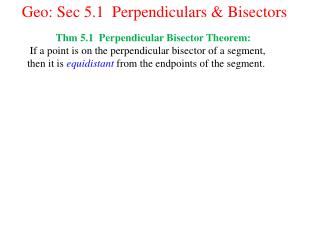
The Perpendicular Bisector Theorem If a point is on the perpendicular bisector of a segment, then it is equidistant from the endpoints of the segment C A B D
The Converse of the Perpendicular Bisector Theorem If a point is equidistant from the endpoints of a segment, then the point lies on the perpendicular bisector of the segment C A B
Distance from a point to a line – The length of the perpendicular segment from the point to the line Q f P PQ is the distance from Point P to line f
The Angle Bisector Theorem If a point is on the bisector of an angle, then the point is equidistant from the sides of the angle F C A B D E
Ex#1 Find the perimeter of ACBD C By the Perpendicular Bisector Theorem, 5 5 A B 6 6 So the perimeter of ACBD is 22 D
Ex#2 Find the value of x, then find FD and FB C By the Angle Bisector Theorem, B D F 5x 2x + 24