
Elderly Mortality Projections and Financial Impacts through CARESIM and FRS Data Analysis
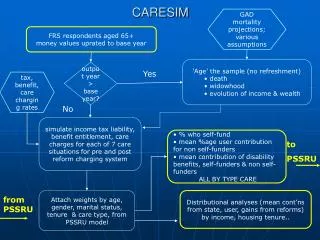
This analysis focuses on mortality projections for individuals aged 65 and above using data from the CARESIM and FRS. It considers various assumptions regarding money values, prompting discussions on widowhood, the evolution of income and wealth, and the implications of tax, benefits, and care charging rates. The study examines the percentage of self-funders and mean contributions from both self-funders and non-self-funders across different care types. Additionally, it explores socioeconomic factors influencing mortality, availability of carers, and the effects of potential reforms.

Elderly Mortality Projections and Financial Impacts through CARESIM and FRS Data Analysis
E N D
Presentation Transcript
GAD mortality projections; various assumptions CARESIM FRS respondents aged 65+ money values uprated to base year • ‘Age’ the sample (no refreshment) • death • widowhood • evolution of income & wealth output year > base year? Yes tax, benefit, care charging rates No simulate income tax liability, benefit entitlement, care charges for each of 7 care situations for pre and post reform charging system • % who self-fund • mean %age user contribution for non self-funders • mean contribution of disability benefits, self-funders & non self-funders • ALL BY TYPE CARE to PSSRU Attach weights by age, gender, marital status, tenure & care type, from PSSRU model Distributional analyses (mean cont’ns from state, user, gains from reforms) by income, housing tenure.. from PSSRU
CARESIM: scope for links with other WPs & models • improved/alternative mortality • by socioeconomic status • correlating mortality of partners • availability of carers (and hence eligibility for Carers’ Allowance) • refreshing the sample – using/learning from PPI model
