
Key Events Leading to American Revolution: Protests & Acts Against British Rule
This overview explores critical events that fueled colonial resistance against British rule leading to the American Revolution. It begins with the Proclamation of 1763, drawing a line that colonists ignored, followed by the Sugar Act of 1764 inciting cries of “No Taxation without Representation.” The Stamp Act of 1765 saw the formation of the Sons of Liberty and widespread boycotts. Subsequent acts, including the Townshend Acts and the Quartering Act, intensified tensions, culminating in the Boston Tea Party and the harsh Intolerable Acts of 1774, which unified the colonies in protest.

Key Events Leading to American Revolution: Protests & Acts Against British Rule
E N D
Presentation Transcript
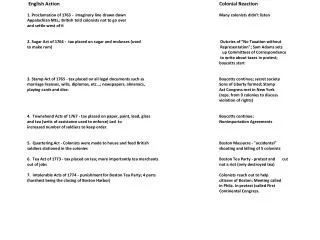
English Action Colonial Reaction1. Proclamation of 1763 - imaginary line drawn down Many colonists didn't listenAppalachian Mts.; British told colonists not to go over and settle west of it2. Sugar Act of 1764 - tax placed on sugar and molasses (used Outcries of "No Taxation withoutto make rum) Representation"; Sam Adams sets up Committees of Correspondence to write about taxes in protest; boycotts start3. Stamp Act of 1765 - tax placed on all legal documents such as Boycotts continue; secret societymarriage licenses, wills, diplomas, etc...; newspapers, almanacs, Sons of Liberty formed; Stamp playing cards and dice. Act Congress met in New York (reps. from 9 colonies to discuss violation of rights)4. Townshend Acts of 1767 - tax placed on paper, paint, lead, glass Boycotts continue; and tea (writs of assistance used to enforce) Led to Nonimportation Agreements increased number of soldiers to keep order.5. Quartering Act - Colonists were made to house and feed British Boston Massacre - "accidental" soldiers stationed in the colonies shooting and killing of 5 colonists 6. Tea Act of 1773 - tax placed on tea; more importantly tea merchants Boston Tea Party - protest and cut out of jobs not a riot (only destroyed tea)7. Intolerable Acts of 1774 - punishment for Boston Tea Party; 4 parts Colonists reach out to help (harshest being the closing of Boston Harbor) citizens of Boston; Meeting called in Phila. In protest (called First Continental Congress.