Download
1 / 24
240 likes | 354 Vues
The Region Forward Update from June 20, 2014, outlines a comprehensive strategy for creating a more prosperous, accessible, livable, and sustainable metropolitan Washington area. It highlights nine goal areas including land use, transportation, and public safety, while emphasizing the importance of Activity Centers for regional growth. Through voluntary local commitments and improved accessibility to vocational training, the initiative aims to ensure affordable housing, enhance regional air quality, and achieve sustainability goals by 2025, making communities more vibrant and connected.

E N D
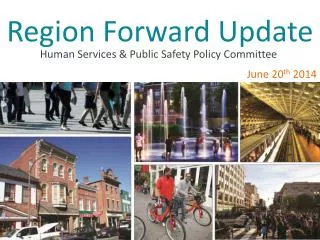
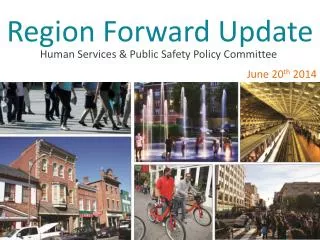
Region Forward Update Human Services & Public Safety Policy Committee June 20th 2014
Region Forward COG’s vision for a more Prosperous, Accessible, Livable,andSustainable metropolitan Washington Livability Accessibility Sustainability Prosperity
Region Forward: 9 Goal Areas Land Use Transportation Environment Climate & Energy Economic Housing Health Education Public Safety
Prosperity Improve access to vocational training Median wage growth exceeds inflation
Accessibility 2020: Housing + Transportation Cost in Activity Centers will not exceed 45% of AMI Capture 75% of commercial construction & 50% of households in Activity Centers Tysons Corner All Regional Activity Centers will have transit
Livability Beginning in 2012, 80% of new or preserved affordable housing units in activity centers Reduce bike/ped fatalities
Sustainability By 2025 achieve 100% of Chesapeake Bay Water Quality Goals By 2020 All new residential & commercial buildings LEED Silver 2014 Regional air quality will improving beyond federal standards
What Are Activity Centers? • Places targeted for regional growth • Urban & suburban centers, traditional towns, emerging communities • Consistent with local planning • Mixed-use • Aligned with existing &planned transportation network
Place + Opportunity • Resource to support local government investment in Activity Centers • Regional perspective: - Identifies similar challenges & needs of Centers throughout the region - Provides tailored tools and strategies to help communities meet their aspirations • Facilitates regional knowledge-sharing—local governments can learn from each other
Report Overview 2/3 of Centers Analyzed PlaceTypes OpportunityTypes Goals Goals Strategies Strategies Tools Tools
Methodology • Places Typology • Urban Form • Built environment characteristics, • Walkability (State of Place™) • Partner: Urban Imprint • Market Characteristics • Office rents (Costar) • Residential rents (REIS) • Market potential (Metrologic™ model) • Partner: RCLCO
State of Place™ – measures attributes along 10 urban design dimensions IMI/SoP placeholder slide
6 Place Types • Urban Center • Dense Mixed-Use • Suburban Multi-Use Downtown DC Reston Town Center Falls Church • Satellite City • Revitalizing Urban • Close-in & Urbanizing West Hyattsville Minnesota Avenue Downtown Frederick
Opportunity Typology • Vulnerability • Concentration of households below 40% of area median income (American Community Survey) • Partner: Reconnecting America • Assets • Housing affordability (CNT Housing + Transportation Index) • Job access by transit (COG TPB Accessibility Model) • Income diversity (Esri Business Analyst from ACS data) • Partner: Reconnecting America
4 Opportunity Types • Transforming • Transitioning • Connected Core Poplar Point Wheaton • Stable Clarendon King Farm
Project Considerations/Lessons Learned • Simplicity of typology • Determine main focus/need and build the typology around that (place-making v. equity v. TOD/transit-readiness v. health, etc.) • Who are the intended audiences? Does the project need to be approved/adopted by a Board? • Will inform whether methodology & report are more technical/quantitative v. qualitative • Consider focus groups with intended audiences/stakeholders
Next Steps for Region Forward Coalition • July 18th - “Prosperity / Livability” • “Bursting the Bubble” - Commonwealth Institute • “Housing Security Study” - Urban Institute / Community Foundation • Fall – “Livability” • Mark Fenton - www.MarkFenton.com • Health goals, targets and indicators