Exploring Europa: Jupiter's Icy Moon and Its Potential for Life
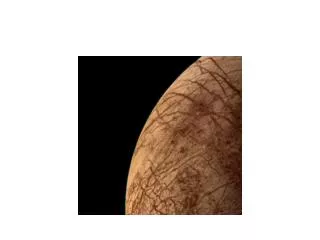
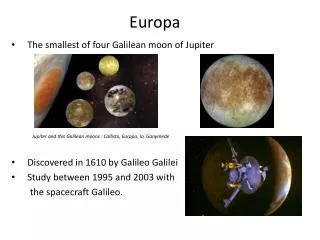
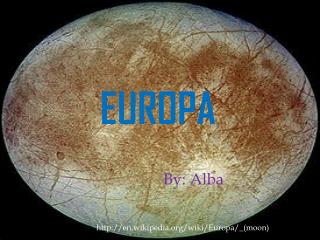
Europa, the sixth-largest moon of Jupiter, has captivated scientists since its discovery by Galileo Galilei. Its smooth ice-covered surface and potential subsurface ocean raise intriguing questions about the possibility of life beyond Earth. The moon is named after a figure in Greek mythology, and studies suggest that beneath its frozen crust, harsh conditions may support microbial life. Ongoing exploration and missions aim to uncover the secrets of Europa’s geology, ice, and potential hydrothermal vents, which could be key to searching for extraterrestrial organisms.

Exploring Europa: Jupiter's Icy Moon and Its Potential for Life
E N D
Presentation Transcript
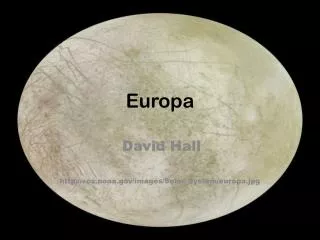
Europa David Hall http://sos.noaa.gov/images/Solar_System/europa.jpg
Discovery Galileo Galilei http://www.malaspina.com/jpg/galileo.jpg
Sixth Largest Moon http://upload.wikimedia.org/wikipedia/commons/f/fb/Europa_Earth_Moon_Comparison.png
Named After Europa http://www.metmuseum.org/toah/images/h2/h2_11.149.1.jpg
Jupiter and Earth • http://upload.wikimedia.org/wikipedia/commons/4/48/Mercury_Earth_Comparison.png
No Satellites http://en.wikipedia.org/wiki/File:Cryobot.jpg
Surface http://images.google.com/imgres?imgurl=http://www.phys.ncku.edu.tw/~astrolab/mirrors/apod/image/europa3_vg_big.jpg&imgrefurl=http://www.phys.ncku.edu.tw/~astrolab/mirrors/apod/ap960813.html&usg=__t-59zrN9ZTAlmxZ3yNMCm_UR35c=&h=488&w=1280&sz=149&hl=en&start=2&um=1&tbnid=4PcDueeZDycK8M:&tbnh=57&tbnw=150&prev=/images%3Fq%3Deuropa%2527s%2Bsurface%26hl%3Den%26safe%3Dactive%26rls%3Dcom.microsoft:*%26sa%3DN%26um%3D1
Life on Europa http://bioinfo.bact.wisc.edu/themicrobialworld/Hydrothermal_vent.jpg