Download
1 / 34
340 likes | 453 Vues
The EU-MOP system provides critical response capabilities for marine oil pollution across European waters. This document outlines various EU-MOP unit types including L-size, M-size, and S-size vessels, along with their operational capabilities in different sea states. Through strategic, tactical, and operational level analyses, case studies from incidents in Spanish and Greek waters demonstrate the system's effectiveness in real spill scenarios. This assessment emphasizes the overall judgment of EU-MOP's potential for oil spill cleaning and the practicality of its applications in marine environments.

E N D
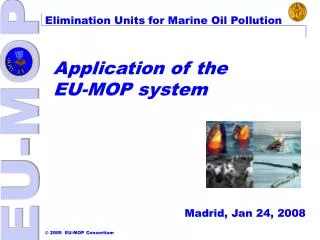
Elimination Units for Marine Oil Pollution Application of the EU-MOP system Madrid, Jan 24, 2008
Overview • EU-MOP Unit Types • EU-MOP Operational Capabilities • EU-MOP Response Rationale • Case-studies: Application of EU-MOP in European waters • Overall judgment of EU-MOP oil-spill cleaning potential
EU-MOP Unit Types L-size Catamaran L-size MonoCat
EU-MOP Unit Types M-size Catamaran M-size MonoCat
EU-MOP Unit Types S-size
EU-MOP Operational Capabilities • L-size and M-size Up to Sea State 4 e.g. open ocean / enclosed sea • S-size (mainly) Sea State 1 e.g. shallow water / port areas
EU-MOP Operational Capabilities Possible Locations for EU-MOP Solution
EU-MOP Response Rationale Strategic Level
EU-MOP Response Rationale Tactical Level
EU-MOP Response Rationale Operational Level
Case-studies: Application in European waters • Case-studies of real spill incidents and the application of EU-MOP on: • Strategic Level • Tactical Level • Operational Level • have been analysed for real spill incidents in: • Spanish waters (Sierra Nava incident) • Greek waters (Nordland incident) • UK waters (Tenby Harbor incident) • Next, the Spanish and Greek case-studiesare briefly presented
The Spanish Case: Sierra Nava Spill Strategic Level Analysis: South of Spain (broader risk area) 3 candidate facility sites 4 potential spill sites 3 2 3 4 1 1 2
The Spanish Case: Sierra Nava Spill Strategic Level Analysis: Probabilistic Data (abstract)
The Spanish Case: Sierra Nava Spill Strategic Level Analysis: Simulation Results Type 4: 2 units Type 2: 14 units
The Spanish Case: Sierra Nava Spill Strategic Level Analysis: Simulation Results* • *Assumption: the weathering of oil is not taken into account
The Spanish Case: Sierra Nava Spill Tactical Level Analysis: 350 tonnes spill (Sierra Nava) Scenario based on actual response Actual response: 1 skimmer and 1 tug boat Removed 35 tonnes in 5 days Spill site
The Spanish Case: Sierra Nava Spill Tactical Level Analysis: 350 tonnes spill (Sierra Nava) Scenario based on actual response (1 facility) and strategic simulation (14 M-size Cat units) Storage of 14 “Type 2” (M-size Cat) units in Algeciras Weathering of oil taken into account Type 2: 14 units Spill site
The Spanish Case: Sierra Nava Spill Tactical Level Analysis: 350 tonnes spill (Sierra Nava) Simulation results DAY1 7 “Type 2” (M-size Cat) units dispatched to spill site 120 tonnes removed Type 2: 14 units Spill site
The Spanish Case: Sierra Nava Spill Tactical Level Analysis: 350 tonnes spill (Sierra Nava) Simulation results DAY2 5 “Type 2” (M-size Cat) already at the spill site remove 114 tonnes Type 2: 7 units Spill site
The Spanish Case: Sierra Nava Spill Tactical Level Analysis: 350 tonnes spill (Sierra Nava) Simulation results: Overall response
Case-study: Application in Greek waters Strategic Level Analysis: South of Peloponnesus (broader risk area)
Case-study: Application in Greek waters Strategic Level Analysis: Simulation Results Type 4: 2 units Type 2: 8 units
Case-study: Application in Greek waters Strategic Level Analysis: Simulation Results* • *Assumption: the weathering of oil is not taken into account
Case-study: Application in Greek waters Tactical Level Analysis: 110 tonnes spill (Nordland) Scenario 1 (based on strategic)
Case-study: Application in Greek waters Tactical Level Analysis: 110 tonnes spill (Nordland) Scenario 1 Simulation Results 7 “Type 2” (M-size Cat) units dispatched to spill site Full oil recovery within 25 hours
Case-study: Application in Greek waters Tactical Level Analysis: 110 tonnes spill (Nordland) Scenario 2 (comparison with actual response) Actual response: 1 Aktaia vessel and 1 weir skimmer dispatched from Piraeus Removed 14 tonnes in 8 days
Case-study: Application in Greek waters Tactical Level Analysis: 110 tonnes spill (Nordland) Scenario 2 (comparison with actual response) Scenario 2: Storage of 12 “Type 2” (M-size Cat) units in Piraeus Weathering of oil taken into account
Case-study: Application in Greek waters Tactical Level Analysis: 110 tonnes spill (Nordland) Scenario 2: Simulation Results 5 “Type 2” (M-size Cat) units dispatched to spill site 106 tonnes removed within 35 hours
Case-study: Application in Greek waters Tactical Level Analysis: Results assessment (of a number of scenarios) *In scenario 4, the high figure is due to the fact that only a fraction of the spilled oil was collected because of imposed operational limitations
Case-study: Application in Greek waters Operational Level Analysis: swarms of 8 M-size or 8 L-size units considered
Case-study: Application in Greek waters Operational Level Analysis: swarms of 8 M-size or 8 L-size units considered
Case-study: Application in Greek waters Cost-Benefit Analysis Greek waters scenario (South of Peloponnesus) considering spill incidents similar to Nordland
Application of the EU-MOP system EU-MOP is on the right track and is a promising solution for the future of oil confrontation