Download
1 / 10
100 likes | 228 Vues
This guide explains the concepts of concavity and the Second Derivative Test in calculus. It covers how to determine whether a function is concave up or down based on the sign of the second derivative, f''(x). It details the implications of f''(c) for relative maxima and minima and outlines how to find increasing and decreasing intervals, as well as inflection points. Examples illustrate the analysis of given functions, including their first and second derivatives, and how to identify critical points and their nature.

E N D
3.4 Concavity and the 2nd Derivative Test
concave up: f’ is increasing. tangent lines are below the graph. concave down: f’ is decreasing. tangent lines are above the graph.
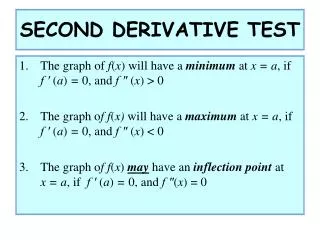
Test for Concavity • If f”(x) > 0 for all x in I, then f is concave up. • If f”(x) < 0 for all x in I, then f is concave down. 2nd Derivative Test (Use C.N.’s of 1st Derivative) • If f”(c) > 0, then f(c) is a relative min. • If f”(c) < 0, then f(c) is a relative max. • If f”(c) = 0, then the test fails. No min. or max.
Ex. 1 Determine where f(x) = 6(x2 + 3)-1 is increasing, decreasing, has max’s or min’s, is concave up or down, has inflection points. f’(x) = -6(x2 + 3)-2(2x) C.N. = 0 + 0 (0,2) max. 1st der. test
C.N.’s -1, 1 -1 1 down concave up up (-1, ) (1, ) Inflection points
2nd Derivative Test Plug C.N.’s of 1st der. into 2nd derivative. C.N. from 1st der. was 0. 0 is a maximum Remember, a neg. in the 2nd der. means concave down. Therefore, the point is a maximum.
There are no x-intercepts (0,2) max (1, 3/2) Inf. pt. (-1, 3/2) Inf. pt.
Ex. 2 Determine where f(x) = x4 – 4x3 is increasing, decreasing, has max’s or min’s, is concave up or down, has inflection points. f’(x) = 4x3 – 12x2 = 4x2(x – 3) C.N.’s 0, 3 0 3 dec. dec. inc. (3, ) -27 min. 1st der. test f”(x) = 12x2 – 24x = 12x(x – 2) = 0 C.N.’s 0, 2 2nd der. test up down up 0 2 f”(0) f”(3) = 0 > 0 Inf. pt.’s (0, ) (2, ) 0 -16 (3,-27) is a min.
9 -9 -16 -27
Given the graph of f, trace the graph of f’, and f”, on the same axes. f’ f f”