Class Notes 3: Macromolecules
Macromolecules are large, complex molecules essential for life, primarily categorized into four types: carbohydrates, lipids, proteins, and nucleic acids. Carbohydrates, composed of carbon, hydrogen, and oxygen, provide energy for cells and form part of plant cell structures like cellulose. Lipids, including fats and oils, serve as energy sources and structural components. Proteins are polymers made from amino acids, crucial for various bodily functions, including digestion and vision. Nucleic acids, made of nucleotides, store and transmit genetic information necessary for protein synthesis.


Class Notes 3: Macromolecules
E N D
Presentation Transcript
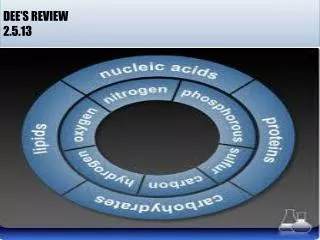
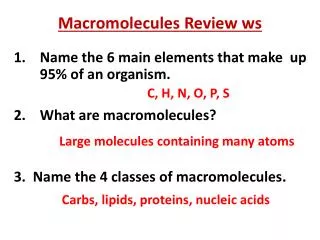
I. Macromolecules • Macromolecules are really big molecules. • There are 4 main types in living things: carbohydrates, lipids, proteins, and nucleic acids and they are mostly made of the elements HONC.
II. Carbohydrates • Carbohydrates are made of C, H, and O. • Can be broken down to provide energy for cells. • Major part of plant cells-cellulose. simple carbohydrate example
III. Lipids- AKA fats & oils • Include fats, oils, and cholesterols. • Can be used for energy or cell structure Double bonds Single bonds
IV. Proteins • A protein is a polymer made of the monomers amino acids. • Proteins help with digestion, movement, and even vision.
V. Nucleic Acids • Contain the information cells use to build proteins from amino acids. • Made of nucleotides that contain a sugar, a phosphate, and a nitrogen base.
Summary What are macromolecules? What are the four macromolecules in the human body?