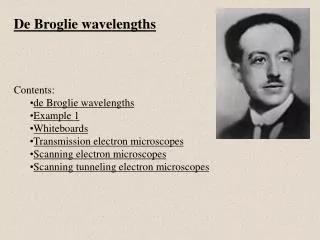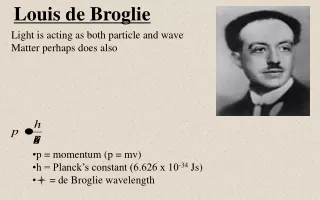
Louis de Broglie
240 likes | 407 Vues
This article explores the concept of de Broglie wavelength, derived from Louis de Broglie's hypothesis that all matter exhibits wave-like properties. It covers the relationship between momentum, Planck's constant, and the de Broglie wavelength. The text includes examples calculating the wavelength of various particles, such as a ball and an electron, as well as applications like electron microscopes. The dual behavior of particles as both waves and particles is discussed, shedding light on the complementary nature of light and matter interactions in quantum mechanics.


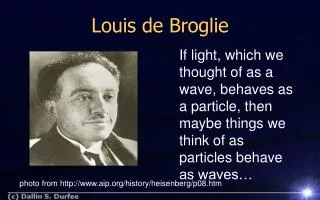
Louis de Broglie
E N D
Presentation Transcript
Louis de Broglie • p = momentum (p = mv) • h = Planck’s constant (6.626 x 10⁻³⁴ Js) • = de Broglie wavelength Light is acting as both particle and wave Matter perhaps does also
Davisson-Germer (Interference)
p = momentum (p = mv) • h = Planck’s constant (6.626 x 10⁻³⁴ Js) • = de Broglie wavelength Example 1: What is the de Broglie wavelength of a .145 g ball going 40. m/s? (1.1 x 10⁻³⁴ m) (too small)
Ve = 1/2mv2 • V = accelerating voltage (V) • e = elementary charge • (1.602x10⁻¹⁹ C) • m = particle mass (kg) • v = velocity (m/s) • p = h/ • p = momentum (p = mv) • h = Planck’s constant • (6.626 x 10⁻³⁴ Js) • = de Broglie wavelength Example 2: Through what potential must you accelerate an electron so that it has a wavelength of 1.0 nm? (1.504 V)
Applications of “matter” waves • Electron Microscopes • Image resolution • = h/p • Electric or magnetic lenses • Gertrude Rempfer (PSU)
Scanning tunneling electron microscope Actually can image atoms and molecules (Novellus)
Soooo – Is/are Light/electrons a wave or particle????? Wave behaviour Particle behaviour Complementarity/Duality Wave XOR Particle behaviour explains the behavior. Behaviour depends on situation. (Other particle interactions)
What is the de Broglie wavelength of an electron going 1800 m/s? (3) m = 9.11 x 10⁻³¹ kg p = mv p = h/ p = (9.11 x 10⁻³¹ kg)(1800 m/s) = 1.6398 x 10⁻²⁷ kg m/s = h/p = (6.626 x 10⁻³⁴ Js)/(1.6398 x 10-27 kg m/s) = 404 nm 404 nm
What is the momentum of a 600. nm photon? p = h/ p = (6.626 x 10⁻³⁴ Js)/(600. x 10-9 m) = 1.10 x 10⁻²⁷ kg m/s 1.10 x 10⁻²⁷ kg m/s
Electrons in a microscope are accelerated through 12.8 V. What de Broglie wavelength will they have? p = h/ Ve = 1/2mv2 Ve = 1/2mv2, v2 = 2Ve/m, v = √(2(12.8 V)(1.602E-19 C)/(9.11E-31 kg)) = 2121739.443 m/s p = h/, = h/p = h/mv = (6.626E-34 Js)/((9.11E-31 kg)(2121739.443 m/s)) = 3.428E-10 m 3.428E-10 m
You want to use an electron to have the same wavelength as the waves on a violin string. Through what potential do you accelerate them. (violin strings are about 34 cm long, so the fundamental is about .68 m long) p = h/ = (6.626E-34 Js)/(.68 m) = 9.74412E-34 kg m/s p = mv, v = p/m = (6.626E-25 kg m/s)/(9.11E-31 kg) = 0.001069607 m/s Ve = 1/2mv2, V = 1/2mv2/e = 1/2(9.11E-31 kg)(0.001069607 m/s)2/(1.602E-19 C) = 3.25293E-18 V 3.25293E-18 V
A 300. MW 620. nm laser is putting out 9.36 x 1026 photons per second. since F = p/t, and t = 1 second, what is the total thrust of the laser? (2) for 1 photon: p = h/ for 5 photons: 5p = 5h/ p = (6.626 x 10⁻³⁴ Js)/(620. x 10-9 m) = 1.0687 x 10⁻²⁷ kg m/s total p change = (9.36 x 1026 )(1.0687 x 10⁻²⁷ kg m/s) = 1.00 N 1.00 N