Download
1 / 18
180 likes | 289 Vues
This presentation by Paul Bozek, P.Eng., CIH, ROH, discusses the critical aspects of managing combustible dust in manufacturing settings in Ontario. It covers the definition of combustible dust, typical hazardous processes, and the necessary controls to mitigate risks. Participants will learn about regulatory requirements, ignition sensitivity, and practical examples of effective dust management. This session also highlights the importance of pre-start Health and Safety review requirements and best practices for ensuring safety in the workplace.

E N D
Managing Combustible Dust in Manufacturing - My Experience in Ontario Paul Bozek, PEng CIH ROH RT 215 Managing and Regulating Combustible Dust
Outline • Definition of “Combustible” Dusts • Typical hazardous processes • Typical controls and Issues (examples) • Regulatory Requirements/Guidelines and Programs to manage the risk
Manufacturing Sites Not a comprehensive list, just example industries
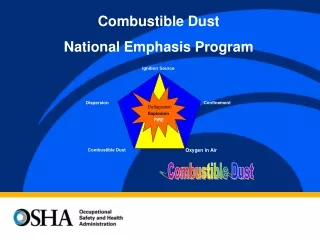
Definition of “Combustible Dust” [Pmax x (dP/dt)max]2 Explosion Severity = ------------------------------ (>0.5) [Pmax x (dP/dt)max]1 [MIT x MIE x MEC]1 Ignition Sensitivity = ------------------------------- (>0.2) [MIT x MIE x MEC]2 1 = Pitt Coal 2 = Subject Dust
Definition of “Combustible Dust” • “…..presents risk of fire or deflagration hazard when suspended in air…. • Definition used to include, “<420 microns” • Good Aspects • Not “normally present” suspended in occupied workspaces • Min Explosive Conc. often 1000x OEL
Definition of “Combustible Dust” Problems: (in Hazard Identification) • Parameters are size dependent! • “as is” testing vs “sieve <420 microns” • Full testing is expensive ($3,000+) • Testing for KST alone gives only (dp/dt)max • Moisture content, fat content affect results • MSDS’s often silent or misleading • “as is” product may be too large to be combustible but may contain fines that are combustible
Typical “Settled Dust” Hazards Re-suspended Dust hazard – requires Electrical “Hazardous Location” (Class 2 Division 1 or 2).
“Settled Dust” Hazard Control Positive press? Maintenance Ignition Controls Documented Cleaning Schedule
Typical Hazardous Processes(Explosions Inside Equipment) • Silo and Container Filling • Pneumatic conveying • “Air Material Separators” • Dust Collectors • Cyclones • Size reduction processes (eg grinding) • Sieving, Blending • Drying (eg fluidized bed)
Fireball hazard – Size? Where? Alternately, “suppression” Control: Explosion Venting Vents may be needed in ducts or piping
Dust Collector :Explosion Vent - Locations Vent duct to outdoors “Flameless” Vent
Directly Outside or Inside + secondary filter + “Hazloc” Dust Collector – Air Discharge Location?
Drawing stamped by P.Eng Elec equipment specs meet “Hazloc” classification? Installation inspected by Electrical Authority? Lift trucks rated for Hazloc? Electrical “Hazardous Locations”
Issues: Plastic Containers/Liners Size matters – static can build-up on containers or in bulk powders during transfer
Combustible Dust Policy/Programs • Identify, Assess Risk, Control • Recognizing its’ presence historically a problem • Scope of Program Requirements • OH&S Act, Fire Codes, many best practice guides (NFPA) • Change Management • A good time to review compliance/conformance • In Ontario, “Pre-Start H&S Review” requirements have triggered good project-based reviews
Ontario: “Pre-Start H&S Review” Report Requirements • Legally required when new or modified processes • “process involves a risk of ignition or explosion that creates a condition of imminent hazard to a person’s health or safety” • “use of a dust collector involves a risk of ignition or explosion” • Guidelines from Ministry and PEO for P.Eng • Scope of report goes well beyond strict compliance • Includes NFPA 68, 69, 499, 505 & ACGIH Ind Vent.
Thank You! – Acknowledgement: Paul Bozek, PEng CIH ROH p.bozek@utoronto.ca RT 215 Managing and Regulating Combustible Dust