Comprehensive Introduction to Object-Oriented and Classical Software Engineering
This course provides an in-depth overview of software engineering principles, focusing on both classical and object-oriented paradigms. Over the duration, students will explore the software life cycle, the software process, team dynamics, and crucial tools of the trade. Key topics include requirements analysis, design methodologies, implementation, and post-delivery maintenance. Collaborative projects, team formation, and practical assignments will guide students through the stages of software development, culminating in presentations and final deployment, with an emphasis on group synergy and documentation.

Comprehensive Introduction to Object-Oriented and Classical Software Engineering
E N D
Presentation Transcript
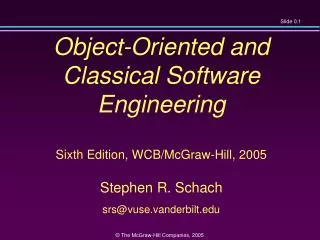
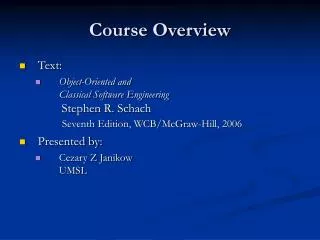
Course Overview • Text: • Object-Oriented and Classical Software EngineeringStephen R. SchachSeventh Edition, WCB/McGraw-Hill, 2006 • Presented by: • Cezary Z JanikowUMSL
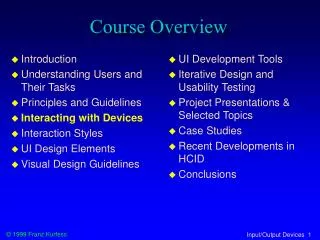
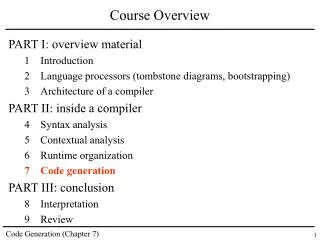
First 5-6 weeks 1. Scope of Software Engineering 2. Software Life-Cycle Models 3. The Software Process 4. Teams 5. Tools of the Trade 6. Testing 7. Modules to Objects 8. Reusability and Portability 9. Planning and Estimating
Mid Semester • Test 1 • Team formation, project initiation and homework in groups • Project in Teams • Individual assignment presentations
Second Part 10. Requirements • Sample Case Study begin 11. Classical Analysis 12. Object-Oriented Analysis 13. Design 14. Implementation 15. Postdelivery Maintenance 16. More on UML • Continue Project along the stages, with some major presentations at either completion of a stage or an iteration • Test 2 • Final deployment and presentations
Course Overview • Some Unified Process (UP, RUP) • Some UML • Some OO analysis/design • Concentrate not on a single technique, process, or notation, but on group synergy, inception/requirements, documentation, development in iterations, deployment, presentations