Understanding Microcirculation and Fluid Movement Across Capillary Walls
This text provides an overview of microcirculation, focusing on the structure and function of capillary walls and the determinants of fluid movement across them. Key factors influencing net fluid movement include capillary hydrostatic pressure, interstitial fluid pressure, plasma colloid osmotic pressure, and interstitial fluid colloid pressure. The balance of these forces is crucial for understanding filtration and reabsorption processes. Additionally, it discusses the lymphatic system and factors affecting lymph flow, highlighting the importance of fluid dynamics in the human body.

Understanding Microcirculation and Fluid Movement Across Capillary Walls
E N D
Presentation Transcript
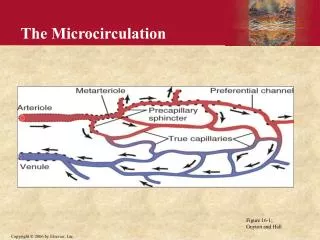
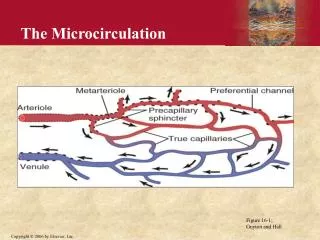
The Microcirculation Figure 16-1; Guyton and Hall
Structure of Capillary Wall Figure 16-2; Guyton and Hall
Interstitium and Interstitial Fluid Figure 16-4; Guyton and Hall
Determinants of Net FluidMovement across Capillaries • Capillary hydrostatic pressure (Pc)-tends to force fluid outward through the capillary membrane. • Interstitial fluid pressure (Pif)- opposes filtration when value is positive. Figure 16-5; Guyton and Hall
Determinants of Net FluidMovement across Capillaries • Plasma colloid osmotic pressure ( c)- opposes filtration causing osmosis of water inward through the membrane • Interstitial fluid colloid pressure ( if) promotes filtration by causing osmosis of fluid outward through the membrane NP = Pc - c - Pif + if Figure 16-5; Guyton and Hall
Plasma Proteins and ColloidOsmotic Pressure • 75% of the total colloid osmotic pressure of plasma results from the presence of albumin and 25% is due to globulins. gm/dl p(mmHg) Albumin 4.5 21.8 Globulins 2.5 6.0 Fibrinogen 0.30.2 Total 7.3 28.0
Determinants of Net FluidMovement Across Capillaries Figure 16-5; Guyton and Hall • Filtration rate = net filtration pressure (NFP) multiplied by the filtration coefficient • Filtration coefficient (Kf) is a product of surface area times the hydraulic conductivity of membrane
Forces Causing Filtration at theArteriole End of the Capillary mmHg Forces tending to move fluid outward: Capillary pressure 30 Negative interstitial free fluid pressure 3 Interstitial fluid colloid osmotic pressure 8 TOTAL OUTWARD FORCE 41 Forces tending to move fluid inward: Plasma colloid osmotic pressure 28 TOTAL INWARD FORCE 28 Summation of forces: Outward 41 Inward 28 NET OUTWARD FORCE 13
Forces Causing Reabsorption at the Venous End of the Capillary mmHg Forces tending to move fluid inward: Plasma colloid osmotic pressure 28 TOTAL INWARD FORCE 28 Forces tending to move fluid outward: Capillary pressure 10 Negative interstitial free fluid pressure 3 Interstitial fluid colloid osmotic pressure 8 TOTAL OUTWARD FORCE 21 Summation of forces: Outward 21 Inward 28 NET INWARD FORCE 7
Net Starling Forces in Capillaries mmHg Mean forces tending to move fluid outward: Mean Capillary pressure 17.3 Negative interstitial free fluid pressure 3.0 Interstitial fluid colloid osmotic pressure 8.0 TOTAL OUTWARD FORCE 28.3 Mean force tending to move fluid inward: Plasma colloid osmotic pressure 28.0 TOTAL INWARD FORCE 28.0 Summation of mean forces: Outward 28.3 Inward 28.0 NET OUTWARD FORCE 0.3
Net Starling Forces in Capillaries • Net filtration pressure of .3 mmHg which causes a net filtration rate of 2ml/min for entire body. Figure opener; Guyton and Hall
Question Utilizing the data below, calculate the rate of net fluid movement across the capillary wall: Pressures (in mmHg) Plasma colloid osmotic = 20 Capillary hydrostatic = 20 Venous hydrostatic = 5 Arterial = 80 Interstitial hydrostatic = -5 Interstitial colloid osmotic = 5 Filtration coefficient = 10 ml/min/mmHg a. 0 ml/min d. 100 ml/min (Reabsorption) b. 10 ml/min (Filtration) e. 10 ml/min (Reabsorption) c. 100 ml/min (Filtration)
Determinants of Lymph Flow • The degree of activity of the lymphatic pump • smooth muscle filaments in lymph vessel cause them to contract • external compression also contributes to lymphatic pumping Figure 16-11; Guyton and Hall
Determinants of Lymph Flow Interstitial fluid hydrostatic pressure Lymph Flow Figure 16-9; Guyton and Hall Figure 16-10; Guyton and Hall