Download
1 / 13
130 likes | 256 Vues
This unit delves into various map projections, specifically Mercator, Peters, and Robinson, highlighting how these representations affect our understanding of the world. It examines the components of maps, including legends, scales, and the significance of political maps, which illustrate human impact on landscapes through city names, borders, and roads. The lessons also cover thematic maps that convey specific subjects and primary versus secondary sources in historical context, guiding students through critical map reading and analysis skills.

E N D
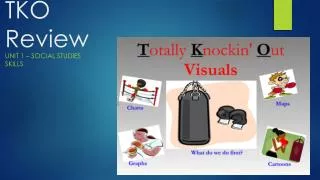
TKO Review Unit 1 – Social Studies Skills
Three World Map ProjectionsMercator, Peters, and Robinson Using the Text book Review Parts of a Map Page XXXV I
Map T – Title • Source Line / Geographic Locator K- Key Words • Captions O- Other Information • Legend – explains colors symbols lines • Scale – Maps proportions
Political Maps • Political maps show how humans have impacted the landscape. For example, city names, roads, country borders, etc. are all part of political maps. • Wars and ethnic conflict are two major causes political maps change. Page S20
Thematic Maps • Gives the reader information about certain subjects/ themes. • ALWAYS have a legend that explains the information. • Title of the map tells you what subject you are learning about Page S22
Independent Practice • 1. A map that shows the population of a place is what kind of map? • 2. If you looked on a map and saw state capitals, cities and state lines, what kind of map would you be looking at?
Page S14 - S18 Charts T – Title • Source Line / Rows / Columns / Axis K- Key Words • Identify the reliability and broad subject O- Other Information • Scale – graphs proportions • Legends - representations
Page S8 Primary Source T – Title • Source Line Document and Author K- Key Words • Identify the Historical Context O- Other Information • Ellipses … to distinguish if pieces of the text are missing
Page S8 Primary Source C. O. R. N. P. E. G.
Secondary Source Page S10 T – Title • Source Line Document and Author K- Key Words • Bold Headings • Citations O- Other Information • Dating terms for sequence of events
Political Cartoon Page S12 T – Title • Source Line Document and Author K- Key Words • Bold Headings • Captions O- Other Information • Symbols and characters / POV
Time Line Page S24 T – Title • Source Line / Dates K- Key Words • Bold Headings • Chronological Terms O- Other Information • Images / Symbols / Legends