Regional Climate Prediction Using NCEP's Spectral Model: Enhancements in Seasonal Forecasting
This study presents the results of a three-year experimental setup utilizing the Nested Global Spectral Model (GSM) and Regional Spectral Model (RSM) for regional climate prediction in the continental US. Spanning from October 2002 to September 2004, the research involved hindcasts and forecasting to assess model performance. Key findings indicate that RSM outperformed SFM in summer predictions and provided enhanced rainfall forecasts compared to CFS post-September 2004. The integration of observational sea surface temperature (SST) and initial conditions significantly improved forecasting accuracy.

Regional Climate Prediction Using NCEP's Spectral Model: Enhancements in Seasonal Forecasting
E N D
Presentation Transcript
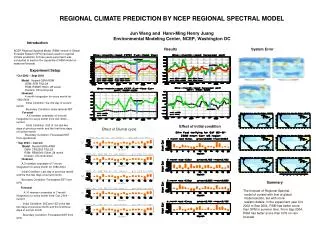
REGIONAL CLIMATE PREDICTION BY NCEP REGIONAL SPECTRAL MODELJun Wang and Hann-Ming Henry JuangEnvironmental Modeling Center, NCEP, Washington DC Results System Error • Experiment Setup • Oct 2002 – Sept 2004 • Model: Nested GSM+RSM • GSM: SFM T62L28 • RSM: RSM97 60km, 28 levels • Domain: US continental • Hindcast • 4 month integration for every month for 1982-2004 • Initial Condition: the first day of current month • Boundary Condition: observational SST • Forecast • A 5-member ensemble of 4 month integration for every month from Oct, 2004 –current • Initial Condition: 00Z of the last two days of previous month and the first three days of current month • Boundary Condition: Forecasted SST from operational • Sep 2004 -- Current • Model: Nested GSM+RSM • GSM: CFS2003 T62L28 • RSM: RSM2004 50km, 28 levels • Domain: US continental • Hindcast • A 3-member ensemble of 7 month integration for every month for 1982-2004 • Initial Condition: Last day of previous month and the first two days of current month • Boundary Condition: Forecasted SST from CFS • Forecast • A 10-member ensemble of 7 month integration for every month from: Oct. 2004 –current • Initial Condition: 00Z and 12Z of the last two days of previous month and the first three days of current month • Boundary Condition: Forecasted SST from CFS Effect of Initial condition Effect of Diurnal cycle Introduction NCEP Regional Spectral Model (RSM) nested in Global Forecast System (GFS) has been used for regional climate prediction. A three years experiment was conducted to explore the capability of RSM model on seasonal forecast. Summary The forecast of Regional Spectral model of consist with that of global model solution, but with more realistic details. In the experiment year Oct 2002 to Sep 2004, RSM has better score than SFM in summer time. From Sep 2004, RSM has better score than CFS on rain forecast.