NDT Enablement Classification Model of Health and Disability
NDT Enablement Classification Model of Health and Disability. Mary Rose Franjoine, PT, DPT, MS, PCS Margo Prim Haynes, PT, DPT, MA, PCS. Readings & References. Required Reading : Neuro-Developmental Treatment Approach Theoretical Foundations and Principles of Clinical Practice Chapter 2

NDT Enablement Classification Model of Health and Disability
E N D
Presentation Transcript
NDT Enablement Classification Model of Health and Disability Mary Rose Franjoine, PT, DPT, MS, PCS Margo Prim Haynes, PT, DPT, MA, PCS
Readings & References Required Reading: • Neuro-Developmental Treatment Approach Theoretical Foundations and Principles of Clinical Practice Chapter 2 References: • www.who.org • Neuro-Developmental Treatment Approach Theoretical Foundations and Principles of Clinical Practice Assignment: • Study Guide: • Learning Activity 2.1.1 (pg 83-85) • Learning Activity 1.1.5 (pg 91) M R Franjoine & M P Haynes
Evolutionary Process Disablement Models • WHO & Nagi Disablement frameworks • NCMRR Disablement Model • Pathophysiology • Impairments • Functional Limitations • Disability • Societal Limitations Enablement Models • International Classification of Function, Disability, and Health • NDT Enablement Classification Model of Health and Disability
Enablement Frameworks, WHY? • Universal, all inclusive model • Multi-dimensional • Cross Cultural • Social and Medical M R Franjoine & M P Haynes
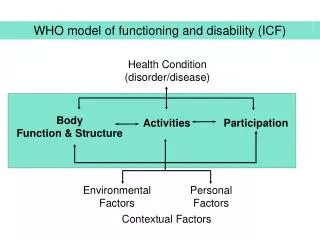
+ Domains - Dimensions NDT Enablement Classification Model of Health and Disability From: NDT Approach Theoretical Foundations & Principles of Clinical Practice, Table 2.1 pg. 82 M R Franjoine & M P Haynes
Participation • Nature and extent of a person’s involvement in life situations • Example: Going to the mall on Saturday afternoon with your friends to “hang” M R Franjoine & M P Haynes
Participation Restrictions • Problem an individual may have in the manner or extent of involvement in life • Example: Can’t “hang” at the mall on Saturday afternoon, because: • Can’t walk fast enough • Can’t walk safe enough • Can’t walk and talk M R Franjoine & M P Haynes
Functional Activities • Directly observable functions • Performance of a task or action by the individual. • Example: Able to get the toy M R Franjoine & M P Haynes
Functional Limitations • Difficulties or inability an individual may have in performing a task or function. • Example: Unable to get the toy • Can’t roll over to get toy • Can’t belly crawl to get the toy • Can’t reach to get the toy M R Franjoine & M P Haynes
Posture & Movement Behaviors • Directly observable • Interaction of the systems & the environment • Examples: • Sitting with PPT • Reaching overhead with IR in shoulder, pronated forearm, and fisted hand • Toe walking • Rib cage elevation during expiration M R Franjoine & M P Haynes
Is the Posture and Movement Behavior Effective or Ineffective? Consider: • Alignment • Weight bearing • Postural Control • Balance • Coordination • Motor planning • Temporal • Spatial • Tone • Movement combinations M R Franjoine & M P Haynes
Single Systems • Body Functions • The physiological or psychological functions of the body system • Body Structure • The anatomical parts of the body such as organs, limbs and their components M R Franjoine & M P Haynes
Body Functions • Mental function • Sensory function and pain • Voice and Speech functions • Functions of Cardiovascular, Hematological, Immunological and Respiratory systems • Functions of the Digestive, Metabolic and Endocrine systems • Genitounitary and Reproductive functions • Neuromusculoskeletal and Movement-related functions • Functions of the Skin and related structures M R Franjoine & M P Haynes
Body Structures • Structures of the nervous system • The eye, ear and related structures • Structures involved in voice and speech • Structures related to the Cardiovascular, Hematological, Immunological and Respiratory systems • Structures related to the Digestive, Metabolic and Endocrine systems • Structures related to the Genitounitary and Reproductive systems • Structures related to Movement • Skin and related structures M R Franjoine & M P Haynes
Impairments Problems in a body function or structure • Single system impairments • Multi-system impairments • Can be temporary or permanent • Can change over time Progression Regression M R Franjoine & M P Haynes
Primary Impairments • Can be single or multi-system • Are a direct result of the Body Function or Body Structure injury, dysfunction, or absence. • Positive Behaviors that are present • Negative Behaviors that are absent M R Franjoine & M P Haynes
Can be single or multi-system Are an indirect result of the Body Function or Body Structure injury, dysfunction, or absence. Secondary Impairments M R Franjoine & M P Haynes
ExamplesNeuromuscular SystemPrimary Positive Impairments • Spasticity • Impaired muscle activation • Excessive co-activation • Stereotypic, atypical movement synergies • Impaired motor execution • Incorrect scaling of muscle force • Inter-limb and Intra-limb dyscoordination M R Franjoine & M P Haynes
ExamplesNeuromuscular SystemPrimary Negative Impairments • Insufficient force generation (weakness) • Impaired anticipatory balance • Hypokinesia • No fractionated movements M R Franjoine & M P Haynes
ExamplesSensory - Perceptual SystemPrimary Positive Impairments • Inaccurate Registration • Inaccurate Modulation • Inaccurate Response M R Franjoine & M P Haynes
Environmental Physical, social, and attitudinal environment in which people live and function. Examples: Facilitators Excellent medical coverage for AT Barriers A home environment where children are to be quiet and well behaved at all times Personal Features of the individual that are not part of a health condition or functional state. Examples: Facilitators Outgoing personality Barriers Shy, quiet Contextual Factors M R Franjoine & M P Haynes
Contextual Factors • Can interact at any level within the model • Can come from within the person • From the family • Can be cultural • Can be environmental M R Franjoine & M P Haynes
NDT Enablement Classification Model of Health and Disability Mary Rose Franjoine, PT, DPT, MS, PCS Margo Prim Haynes, PT, DPT, MA, PCS