Download
1 / 10
100 likes | 219 Vues
The Enlightenment era, marked by influential thinkers like Hobbes, Locke, Montesquieu, Rousseau, and Wollstonecraft, laid the groundwork for modern political philosophy and human rights. Hobbes’ "Leviathan" advocated for a strong, orderly society, while Locke emphasized natural rights of life, liberty, and property. Montesquieu's theory of separation of powers became fundamental to the U.S. Constitution. Rousseau's concept of the Social Contract revealed that true liberty stems from collective agreement. This era transformed governance, laying the foundation for democracy and individual rights.

E N D
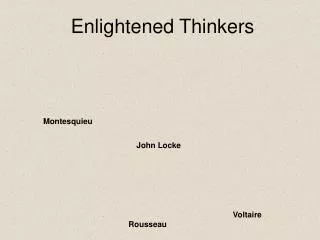
Enlightened Thinkers Montesquieu John Locke Voltaire Rousseau
Thomas _______ • Wrote “Lev____” 1651, is his masterpiece • The _______ needs to control_________. • __________ power for a leader is needed • Absolute materialism; _____ was all that existed • "The life of man is nasty, brutish, and short". • Hobbes wanted a tightly ordered society, ruled by ____ and _______.
John ______(1632-1704) • Two _______ on Government 1690 • __________ the divine rights of kings • _________of government—PROTECTION of NATURAL RIGHTS • Life • Liberty—free choice • Property—own property
Locke • _________ can be land, _______, anything that enables you to sustain life. • Every _______ has these rights. • Unalienable Rights—you can not give them up. • No _______ or ________ can take them away—safety in numbers
If government does not protect your rights or becomes corrupt prosperity _______________ security persecution _______ create societies for mutual protection—make sure we get natural rights. Right of ___________ destroy existing government Society is a human creation Create a new ___________
BARON DE _________(1689-1755) • Spirit of the Law—1748 • believed that all things were made up of rules or laws that never changed. • best governments have power balanced among three groups of officials. (__________ ___ ___________) • His ideas about separation of powers became the basis for the United States _____________. • Local gov’t over ________ gov’t • "In republican governments, men are all equal; equal they are also in despotic governments: in the former, because they are everything; in the latter, because they are nothing."
Jean-Jacques _______ 1712-78 • __________ ________—1763 • For Rousseau the Social Contract is the basic ____ of __________. • Liberty is obedience to the law you have accepted • The people are the source of legitimate ________. • The social contract was______between ___________ and people, but between _________ themselves. • his aim was to create a more virtuous human being. (General Will),
Cesare __________ (1738-1794) • An Essay on Crimes and Punishments (1764) • He applied __________ ideals to crime and ___________. • Government & ________ should be ________ • Criminal justice system • Innocent until proven ________. • Gov’t cannot make you _______ against yourself. • Limitation of _______ and ________. • Right to a _______ trial. • Trial by a jury of __________. • ______________ should fit the crime
Mary __________ • Men believed that woman needed to educated to become a better _____ and _________. • Built on Mary Astell’s idea of freedom for women and woman’s education. • Astell “If all men are born _____, how is it that all women born _______?” • Wollstonecraft encouraged women to enter male dominated fields of medicine and politics.
AMERICA • Enlightened ideas determinedwho or what America would become. • Our ________ of _________& ____________ are enlighteneddocuments • The End