Comprehensive Claytor Lake Debris Study for Effective Shoreline and Habitat Management
150 likes | 271 Vues
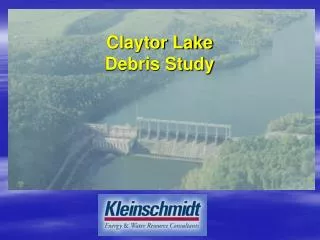
The Claytor Lake Debris Study aims to understand and manage debris accumulation that affects water quality, aquatic life, and recreational activities. Through quarterly field surveys, we will assess types and amounts of debris, identify origins, and evaluate the impact of flow events. The study seeks to balance ecological benefits like fish habitat with challenges posed by debris to aesthetics and recreation. We will develop a practical Debris Management Plan incorporating stakeholder input and existing data, with updates provided throughout the study, concluding with a comprehensive report in May 2008.


Comprehensive Claytor Lake Debris Study for Effective Shoreline and Habitat Management
E N D
Presentation Transcript
Hydro Environmental Services of Kleinschmidt Associates • Shoreline Management Plans (SMP) • Aquatic & Terrestrial Habitat Studies • Fish Populations & Migration Assessments • Wildlife Studies • Instream Flow Modeling • Recreation Management Plans • Water Quality Monitoring & Modeling • Riparian, Wetland & Terrestrial Botanical Studies • River Channel & Habitat Restoration • Threatened & Endangered Species Consultation
Kleinschmidt Experience Regarding Debris Issues • SCEG – Woody Debris & Stump Management Plan • Coosa/Warrior River dams – facilitated a stakeholder group to develop a woody debris policy • Grand River Dam Authority –Shoreline Management Plan
Project Team • Project Manager – Dave Falcinelli • Technical Lead – Mike Hreben • Engineer – Jon Quebbeman • GIS Specialist – Jennifer Wardwell Staff engineers and scientists available to assist as needed.
Understanding Debris Issues • There are a wide variety of debris types and characteristics (e.g., large wood, flotsam, jetsam, urban by-products, etc.) • Debris introduction mechanisms can vary (e.g., chronic and dispersed introduction from mountain and floodplain forests, and acute and concentrated loading from recreational areas) • Nature of debris dispersal within reservoirs can be very complex (eddy concentration/diffusion of buoyant debris, changes in buoyancy associated with residence time alters debris behavior, geographic features that concentrate or disperse debris) • Debris occurrence and associated problems can be very temporal in nature (natural seasonal interactions, recreation activities, seasonality of storms, etc). • Debris provides important habitat for fish and other aquatic species BUT can also be a detriment to aesthetics and recreational activities
Debris Study Objectives: • Determine Amount & Type of Surface Debris • Characterize Debris Types • Evaluate where Debris entered the Lake • Determine the Relationship between Debris Accumulation Areas and Flow Events • Assess methods for reducing and removing debris • Define types of Woody Debris that is Beneficial Fish Habitat • Develop a Debris Management Plan Goal: an assessment of facility operations on debris accumulation.
Amount & Type of Debris • Four Quarterly Field Surveys Over a One Year Period • Flyovers to identify areas of accumulation • Surveys after higher flow events to the extent possible • Representative photos of debris accumulations • Information on Debris types, locations, and quantities • Truck and Boat based surveys to ground-truth debris types and size of accumulations • Information from: FOCL, VDEQ, VDGIF, and other stakeholders • FOCL formed in 1993 due to debris issues
Potential Debris Sources • Locations of debris accumulations documented by surveys and local entities will be assessed to determine likely sources. • Focus will be the New River and other sizeable tributaries • Shoreline activities will also be assessed as potential sources if applicable
Flow/Debris Relationship • Historical Data • Available information on past debris removal efforts • Flow data • Information will be used to develop a qualitative relationship. • Current Information • Conduct field surveys after high flow events (as feasible) • Maintain contact with stakeholders concerned with debris issues
Assessment of Debris Reduction/Removal Programs • Research what is being done at other projects • Literature review • Contact other licensees
Define Types of Woody Debris That Are Beneficial Fish Habitat • Literature Review • Habitat requirements for primary fish species • Contact with VDGIF and VDEQ • Observations by staff scientists during quarterly surveys • Review of other study results (i.e. Aquatic Resource Assessment)
Develop a Debris Management Plan • Review of current debris management on the lake • Research of existing debris management plans at other projects • Incorporate information learned through the other study tasks • Define those management practices that are most applicable to Claytor • Assemble the above information into a debris management plan
Schedule • Begin to acquire existing data January 2007 • Begin quarterly field surveys in the winter or spring 2007 • Provide study updates in May and November 2007 • Final Study Report in May 2008
Claytor Lake Debris Study Questions and Comments?