Penumbral MMFs
270 likes | 379 Vues
This study explores the behavior of penumbral magnetic moving features (MMFs) in sunspots using spectropolarimetric data from Fe 1565 nm. It presents evidence for outward-moving features observed in the penumbral region and discusses their implications for magnetic field dynamics and flow patterns. We analyze data sequences through various sunspot observations, providing insights into the flow and inclination of these magnetic structures. Our findings support earlier studies while highlighting the need for further reduction and analysis to clarify the dynamics involved.


Penumbral MMFs
E N D
Presentation Transcript
Penumbral MMFs S Jaeggli (UHawaii) C Henney (NSO) S Luszcz (Cornell) S Walton (CSUN/SFO) SPW4
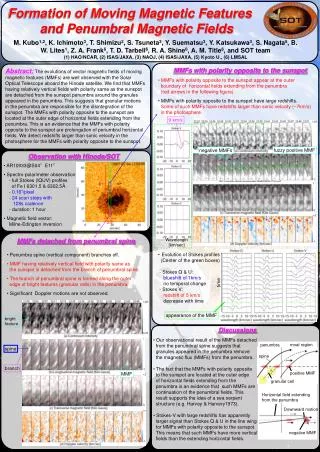
Introduction • MMFs seen in field free photosphere sunspot moat; (Harvey & Harvey 1973) • Evidence for penumbral moving features seen in continuum, B, inclination & velocity in single slit pointing, 2 hr ASP sequence (Lites et al 1998) • MDI data suggest only small fraction of MMFs begin inside the penumbra (Zhang, Solanki & Wang 2003) • Imaging shows outward moving features in outer half of penumbra in continuum, g-band (Bovelet & Weihr 2003) SPW4
Summary • Fe 1565nm spectropolarimetric time series data in two sunspots show moving magnetic features in the mid- to outer sunspot penumbra which move outward and in some cases leave the penumbra and travel across the sunspot moat. SPW4
Observations • Fe 1565nm g=3 line, IQUV, single beam, chopping about 5 s-1, about 4 sec slit step • McM/P main spectrograph, slit scanned. • CSUN/NSO IR camera 256x256 HgCdTe • 24 Jun 2002: NOAA 10008 • 26 Aug 2004: NOAA 10664 SPW4
Observations SPW4
Reduction • Spectral flat fields (i.e. Jones 2001) • Telescope polarization removed using the fully resolved umbral Stokes profiles of Fe line down to few 10-3. (Kuhn et al 1994) • Stokes V magnetograms: subtract blue and red wings of Stokes V • Inversion from Milne-Eddington code (Skumanich & Lites 1987) SPW4
NOAA 10008 • Elliptical penumbral region defined SPW4
Stokes V “magnetogram” movie . SPW4
Stokes V “magnetogram” movie . SPW4
.47 km/s .22 km/s .28 km/s 1.70 km/s .38 km/s .33 km/s .64 km/s .19 km/s .33 km/s .30 km/s Radial Flow – Time Slices • Radial outflow about few tenths of km/s measured by hand SPW4
Radial Flow - LCT SPW4
Radial Flow - LCT SPW4
Theory • A magnetic field line from the spot repeatedly threads the photosphere producing bipoles moved by moat flow (“sea-serpent” idea, Harvey & Harvey 1973) • Problems with magnetic buoyancy led Wilson (1986) to favor disconnected flux loops; Spruit, Title & van Ballegooijen (1987) suggest rising U-loops • Magnetic buoyancy can be overcome by downward convective pumping (Weiss et al 2004) SPW4
Theory • A magnetic field line from the spot repeatedly threads the photosphere producing bipoles moved by moat flow (“sea-serpent” idea, Harvey & Harvey 1973) • Problems with magnetic buoyancy led Wilson (1986) to favor disconnected flux loops; Spruit, Title & Wilson (1987) suggest rising U-loops • Magnetic buoyancy can be overcome by downward convective pumping (Weiss et al 2004) SPW4
Theory • Zhang Solanki & Wang (2003) suggest mass-laden Evershed flux tubes sink outside penumbra when vertical B gradient is removed. • Ryutova et al. (1994) suggest kinks can form from Evershed flow to produce traveling waves along B-field lines. • Schlichenmaier Jahn & Schmidt (1998) compute the dynamics of moving flux tubes within background field, and Schlichenmaier (2002) adds a viscosity term. SPW4
First tests… • B is larger on outer footpoint • Inclination is more vertical on inner footpoint • …but plasma flow seems to be upward on outer footpoint. SPW4
Summary • Penumbral MMFs are seen using IR line (confirming Lites et al 1998) and direct relationship seen with moat MMFs. • Some support for predictions from Schlichenmaier 2002, but some strange correlations too. • (More reduction and analysis needed) SPW4
Radial Flow - LCT SPW4
Radial Flow - LCT SPW4
Stokes V “magnetogram” movie • Within the penumbra there are a few regions of opposite Stokes V, but most cases show only small differences. SPW4