Download
1 / 5
50 likes | 167 Vues
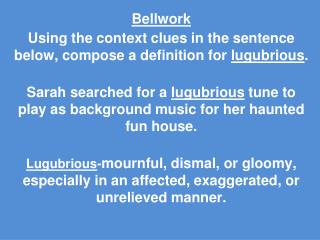
The term "lugubrious," rooted in Latin, describes a deep mourning or sorrow. Emerging in the early 1600s, it derives from "lugere," meaning "to mourn," and is linked to the Proto-Indo-European base *leug-, which signifies causing pain. In literature and speech, "lugubrious" conveys not just sadness but an almost exaggerated sorrowfulness. Its usage spans various contexts, from art to funerals, capturing an aura of gloom. Explore its applications, including examples from literature, and discover how this somber term evokes profound emotions.

E N D
Lugubrious Mournful or glum
Etymology • c.1600, from Latin, lugubris "mournful, pertaining to mourning," from lugere "to mourn," from PIE base *leug- "to break, to cause pain" • (cf. Gk. lygros "mournful, sad," Skt. rujati "breaks, torments," Lettish lauzit "to break the heart").
Use Lugubrious In a Sentence • His client's lugubrious expression tipped the detective off to the fact that there was something lurking beneath the surface of her seemingly optimistic words (from ask.com). • His patriarchy often seemed lugubrious; he would often have tears in his eyes when elucidating all my failings (from Richard Elman, “Namedropping: Mostly Literary Memoirs”) • Previous visits hadn't yielded this art-after-death aura, which had everything to do with two installations on display, work so lugubrious it cast a pall over . . . well, just over me, but dark clouds hovered above the city, and the gloomy weather might as well have emanated from the art ( from Bernard Cooper, "The Uses of the Ghoulish", Los Angeles Magazine, February 2001)
Chopin’s Funeral March • http://www.youtube.com/watch?v=8Fg9hdAiQMQ • Just listen to the lugubrious melody. • FDR’s funeral procession was a lugubrious occasion.
What is Lugubrious? The following can be lugubrious: • Funerals • Widows • Mourners • Depressed individuals • Melody • Voice • Expression • Lyrics • Processions • Newspaper headlines of a catastrophe • Occasions