Automated Generation of SQL Injection and XSS Attacks in PHP Source Code
250 likes | 285 Vues
This study presents a method to automatically create SQL injection and XSS vulnerabilities in PHP applications using input generation and taint tracking techniques. Results include 60 new vulnerabilities discovered. PHP Source Code utilized.


Automated Generation of SQL Injection and XSS Attacks in PHP Source Code
E N D
Presentation Transcript
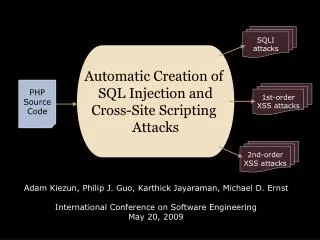
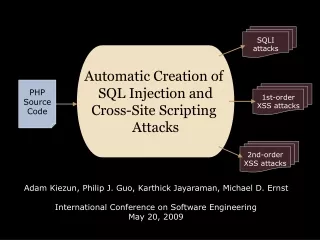
SQLI attacks Automatic Creation of SQL Injection andCross-Site Scripting Attacks PHP Source Code 1st-order XSS attacks 2nd-order XSS attacks Adam Kiezun, Philip J. Guo, Karthick Jayaraman, Michael D. Ernst International Conference on Software Engineering May 20, 2009
Overview Problem: Finding security vulnerabilities (SQLI and XSS) in Web applications Approach: • Automatically generate inputs • Dynamically track taint • Mutate inputs to produce exploits Results: 60 unique new vulnerabilities in 5 PHP applications, first to create 2nd-order XSS, no false positives
PHP Web applications $_GET[] <HTML> … <script> … PHP application $_POST[] http://www.example.com/register.php?name=Bob&age=25 Data HTML PHP on webserver SQL URL Database Web browser
Example: Message board (add mode) if ($_GET['mode'] == "add") addMessageForTopic(); else if ($_GET[‘mode’] == “display”) displayAllMessagesForTopic(); else die(“Error: invalid mode”); function addMessageForTopic() { $my_msg = $_GET['msg']; $my_topicID = $_GET['topicID']; $my_poster = $_GET['poster']; $sqlstmt = ” INSERT INTO messages VALUES('$my_msg’ , '$my_topicID') "; $result = mysql_query($sqlstmt); echo "Thanks for posting, $my_poster"; } $_GET[]: mode = “add” msg = “hi there” topicID = 42 poster = “Bob” Thanks for posting, Bob
Example: Message board (display mode) if ($_GET['mode'] == "add") addMessageForTopic(); else if ($_GET[‘mode’] == “display”) displayAllMessagesForTopic(); else die(“Error: invalid mode”); function displayAllMessagesForTopic() { $my_topicID = $_GET['topicID']; $sqlstmt = ” SELECT msg FROM messages WHERE topicID='$my_topicID’ "; $result = mysql_query($sqlstmt); while($row = mysql_fetch_assoc($result)) { echo "Message: " . $row['msg']; }} $_GET[]: mode = “display” topicID = 42 Message: hi there
SQL injection attack $_GET[]: mode = “display” topicID = 1' OR '1'='1 if ($_GET['mode'] == "add") addMessageForTopic(); else if ($_GET[‘mode’] == “display”) displayAllMessagesForTopic(); else die(“Error: invalid mode”); function displayAllMessagesForTopic() { $my_topicID = $_GET['topicID']; $sqlstmt = ” SELECT msg FROM messages WHERE topicID='$my_topicID’ "; $result = mysql_query($sqlstmt); while($row = mysql_fetch_assoc($result)) { echo "Message: " . $row['msg']; }} SELECT msg FROM messages WHERE topicID='1' OR '1'='1'
First-order XSS attack $_GET[]: mode = “add” msg = “hi there” topicID = 42 poster = MALICIOUS if ($_GET['mode'] == "add") addMessageForTopic(); Example MALICIOUS input: “uh oh<script>alert(‘XSS’)</script>” function addMessageForTopic() { $my_poster = $_GET['poster']; […] echo "Thanks for posting, $my_poster"; } Thanks for posting, uh oh
Second-order XSS attack $_GET[]: mode = “add” msg = MALICIOUS topicID = 42 poster = “Villain” Example MALICIOUS input: “uh oh<script>alert(‘XSS’)</script>” addMessageForTopic() Attacker’s input PHP application Database
Second-order XSS attack $_GET[]: mode = “add” msg = MALICIOUS topicID = 42 poster = “Villain” Example MALICIOUS input: “uh oh<script>alert(‘XSS’)</script>” addMessageForTopic() Attacker’s input PHP application Database $_GET[]: mode = “display” topicID = 42 displayAllMessagesForTopic() echo() Victim’s input Message: uh oh
Architecture Input Generator inputs PHP Source Code Concrete + Symbolic Database Taint Propagator taint sets Attack Generator/Checker Ardilla Malicious inputs
Input generation Input Generator inputs PHP Source Code Goal: Create a set of concrete inputs (_$GET[] & _$POST[]) We use Apollo generator (Artzi et al. ’08), based on concolic execution
Input generation: concolic execution if ($_GET['mode'] == "add") addMessageForTopic(); else if ($_GET[‘mode’] == “display”) displayAllMessagesForTopic(); else die(“Error: invalid mode”); PHP Source Code Input Generator inputs $_GET[]: mode = “1” msg = “1” topicID = 1 poster = “1” $_GET[]: mode = “add” msg = “1” topicID = 1 poster = “1” $_GET[]: mode = “display” msg = “1” topicID = 1 poster = “1”
Example: SQL injection attack 1. Generate inputs until program reaches an SQL statement SELECT msg FROM messages WHERE topicID='$my_topicID‘ function displayAllMessagesForTopic() { $my_topicID = $_GET['topicID']; $sqlstmt = ” SELECT msg FROM messages WHERE topicID='$my_topicID’ "; $result = mysql_query($sqlstmt); $_GET[]: mode = “display” msg = “1” topicID = 1 poster = “1”
Taint propagation inputs PHP Source Code Concrete + Symbolic Database Taint Propagator taint sets Goal: Determine which input variables affect each potentially dangerous value inputs Technique: Execute and track data-flow from input variables to sensitive sinks Sensitive sinks: mysql_query(), echo(), print()
Taint propagation: data-flow inputs inputs Each value has a taint set, which contains input variables whose values flow into it Concrete + Symbolic Database PHP Source Code Taint Propagator taint sets function displayAllMessagesForTopic() { $my_topicID = $_GET['topicID']; $sqlstmt = ” SELECT msg FROM messages WHERE topicID='$my_topicID’ "; $result = mysql_query($sqlstmt); /* {‘topicID’} */ • Taint propagation • Assignments: $my_poster = $_GET[“poster”] • String concatenation: $full_n = $first_n . $last_n • PHP built-in functions: $z = foo($x, $y) • Database operations (for 2nd-order XSS) Taint set Sensitive sink
Example: SQL injection attack 1. Generate inputs until program reaches an SQL statement SELECT msg FROM messages WHERE topicID='$my_topicID‘ 2. Collect taint sets for values in sensitive sinks: { ’topicID’ } function displayAllMessagesForTopic() { $my_topicID = $_GET['topicID']; $sqlstmt = ” SELECT msg FROM messages WHERE topicID='$my_topicID’ "; $result = mysql_query($sqlstmt); /* {‘topicID’} */ Taint set Sensitive sink
Attack generation and checking PHP Source Code inputs taint sets Goal: Generate attacks for each sensitive sink Attack Generator/Checker Malicious inputs • Technique: Mutate inputs into candidate attacks • Replace tainted input variables with shady strings developed by security professionals: • e.g., “1’ or ‘1’=‘1”, “<script>code</script>” Alternative: String constraint solver (Kiezun et al. ’09)
Attack generation and checking inputs taint sets PHP Source Code Malicious inputs Attack Generator/Checker Given a program, an input i, and taint sets for each var that reaches any sensitive sink: res = exec(program, i) Attack generation for shady in shady_strings: mutated_input = i.replace(var, shady) mutated_res = exec(program, mutated_input) if mutated_res DIFFERS FROM res: report mutated_input as attack Attack checking
Attack generation: mutating inputs res = exec(program, i) for shady in shady_strings: mutated_input = i.replace(var, shady) mutated_res = exec(program, mutated_input) if mutated_res DIFFERS FROM res: report mutated_input as attack $_GET[]: mode = “display” topicID = 1' OR '1'='1 $_GET[]: mode = “display” topicID = 1
Example: SQL injection attack 1. Generate inputs until program reaches an SQL statement SELECT msg FROM messages WHERE topicID='$my_topicID‘ 2. Collect taint sets for values in sensitive sinks: { ’topicID’ } 3. Generate attack candidate by picking a shady string $_GET[]: mode = “display” topicID = 1' OR '1'='1 $_GET[]: mode = “display” topicID = 1
Attack checking: diffing outputs res = exec(program, i) for shady in shady_strings: mutated_input = i.replace(var, shady) mutated_res = exec(program, mutated_input) if mutated_res DIFFERS FROM res: report mutated_input as attack • What is a significant difference? • For SQLI:compare SQL parse tree structure • For XSS: compare HTML for additional script-inducing elements (<script></script>) • Avoids false positives from input sanitizing and filtering
Example: SQL injection attack 1. Generate inputs until program reaches an SQL statement SELECT msg FROM messages WHERE topicID='$my_topicID‘ 2. Collect taint sets for values in sensitive sinks: { ’topicID’ } 3. Generate attack candidate by picking a shady string 4. Check by mutating input and comparing SQL parse trees: innocuous:SELECT msg FROM messages WHERE topicID=‘1’ mutated: SELECT msg FROM messages WHERE topicID=‘1’ OR ‘1’=‘1’ 5. Report an attack since SQL parse tree structure differs
Experimental results Total: 60 Main limitation: input generator
Comparison with previous work Defensive coding: + : can completely solve problem if done properly - : must re-write existing code Static analysis: + : can potentially prove absence of errors - : false positives, does not produce concrete attacks Dynamic monitoring: + : can prevent all attacks - : runtime overhead, false positives affect app. behavior Random fuzzing: + : easy to use, produces concrete attacks - : creates mostly invalid inputs
Automatic Creation of SQL Injection and Cross-Site Scripting Attacks • Contributions • Automatically create SQLI and XSS attacks • First technique for 2nd-order XSS • Technique • Dynamically track taint through both program and database • Input mutation and output comparison • Implementation and evaluation • Found 60 new vulnerabilities, no false positives