Download
1 / 33
330 likes | 450 Vues
This presentation by Mike Arov from Louisiana Tech University summarizes the advancements in top quark physics achieved at the Tevatron collider. It highlights the discoveries made by CDF and D0 collaborations, focusing on unique properties, measurement techniques, and analyses related to top quark production, decays, and mass measurements. With a precise measurement of the top quark mass and ongoing searches for new phenomena, this diverse field continues to contribute to our understanding of both the Standard Model and beyond. For further details, visit the collaborations' webpages.

E N D
Top Physics at the Tevatron Mike Arov (Louisiana Tech University) for D0 and CDF Collaborations
Top physics overview • Discovered in 1995 by CDF (19 events) and DO (17 events) • Has many unique properties: • mtop ~ gold atom • Γ~1.4 GeV>>ΛQCD • coupling to Higgs boson ~ 1 Top quark mass is measured with <1% uncertainty
Top physics Only selected new analyses are presented in this talk!
Top production Top pair 15% 85% Single top s-channel t-channel
Tevatron collider at Fermilab • 1.96 TeV p-anti p collider • 396 ns between bunches • Has delivered ~6 fb-1 of • data since 2002, and • Running smoothly: • expect ~10 fb-1 by end • of 2010
Top Production Cross Section in lepton +jets channel Luminosity uncertainty reduced by normalizing to Z cross section B-tagging is a powerful tool for top physics
B-tagging Impact Parameter Tagging (IPT) Neural Network Tagging (NNT) Secondary Vertex Tagging (SVT) e, m Soft Lepton Tagging (SLT)
B-tagging (continue) Good efficiency vs fake rate Works well with top quark
Single Top s-channel t-channel Difiicault W background! Was challenging years after top pair discovery Small cross section B-tagging and multivariate analysis techniques were the key!
Single Top Multivariate Analysis No single variable is sufficient! Boosted Decision Trees (BDT) Neural Networks (NN)
Single Top Results Observation ! |Vtbf1L| = 0.88 ± 0.07
Top quark mass measurement methods • Template method – using MC templates with different masses do fit to top data • Matrix method – using probability density: Acceptance Matrix Element Transfer Function
Top quark mass results (lepton+jets) Independent Jet Energy Scale (JES) measurement allows in-situ calibration
Top Mass Summary 173.1 ±0.6 (stat) ±1.1 (syst) GeV/c2
Measurement of the Forward-Backward Charge Asymmetry in Top-Antitop Production • N+ is the number of events where top has larger rapidity than antitop, while N- is the number of events where it is smaller • In LO QCD it is 0, but in NLO it isn't due to interference between diagrams like these
Asymmetry Results Afb= 12 ±8 (fit) ±1 (stat) Phys. Rev. Lett. 100 , 142002 (2008 ) Afb= 0.193 ±0.065 (stat) ±0.024 (syst)
Spin Correlations k= -0.17 +0.64–0.53 k= 0.320 +0.545 –0.775
Mass Difference Main motivation – check CPT Using matrix method in l+jets channel Likelihood function modified to allow for different top masses DMt= 3.8 ±3.7 GeV
Search for Charged Higgs boson If H+ is lighter than top we can have the following scenarios:
Search for Charged Higgs boson Leptophobic model Tauonic model
Search for ttbar Resonances in the Lepton+Jets (D0) and All Hadronic (CDF) Final State • Invariant mass was plotted for candidate events • Good agreement was observed and no resonant production signal 3 jets 4 jets
Search for ttbar Resonances The limit is set using Mtt distributions For topcolor-assisted technicolor MZ' > 820 GeV (D0) and MZ' > 805 GeV (CDF)
Summary • Top physics at Tevatron is diverse research field covering both SM and beyond SM physics. • In this talk I presented our last combined and most precise measurements of top pair and single cross section. And I also showed latest development on top mass and several properties measurements and searches. • Not all analyses could be shown. A lot more info can be found on the webpages of colaborations: http://www-d0.fnal.gov/Run2Physics/top/top_public_web_pages/top_public.html http://www-cdf.fnal.gov/physics/new/top/public_tprop.html • More exciting measurements and searches are to come.
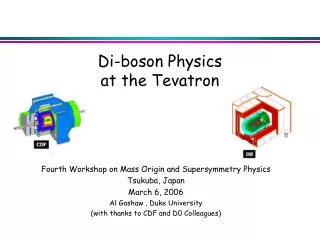
muon system shielding electronics D0 and CDF Detectors
Experimental challenges of top quark physics • Jet Energy Scale • b-tagging • Limited statistics (less so as we collect more data) • Accurate background modeling (mainly W and QCD) • Luminosity measurement uncertainties
Jet Energy Scale The associated statistical and systematic uncertainty is dominant one in top physics
Search for W' decaying to top and b Heavy W' can be observed in single top s channel The right-handed W' limit depends on the unknown mass of the right-handed neutrino, since when M(w'R) <M(nR) only hadronic decays of W are allowed. The following limits were set : • M(w'L) > 731 GeV • M(w'R) > 768 GeV for M(w'R) <M(nR) • M(w'R) > 739 GeV for M(w'R) >M(nR) Phys. Rev. Lett. 100 , 211803 (2008 )
W helicity f0= 0.62 ±0.10 (stat) ±0.05 (syst) f+= -0.04 ±0.04 (stat) ±0.03 (syst) f0= 0.49 ±0.11 (stat) ±0.09 (syst) f+= 0.11 ±0.06 (stat) ±0.05 (syst) SM f0= 0.697±0.012 f+= 0