Implementing Effective Indicators for Education for Sustainable Development (ESD)
This document outlines measures taken by governments to enhance Education for Sustainable Development (ESD) through public awareness initiatives and measurable indicators. It emphasizes the integration of Sustainable Development (SD) themes in educational subjects, criteria for quality ESD teaching materials, and qualitative outcomes reflecting values and local culture. Guidelines for classroom practices highlight critical thinking, cooperative learning, and appreciation of diversity, ensuring a holistic approach to ESD. The work aims to foster international collaboration and research support within the educational framework.

Implementing Effective Indicators for Education for Sustainable Development (ESD)
E N D
Presentation Transcript
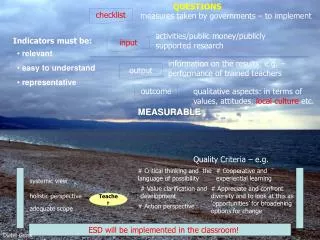
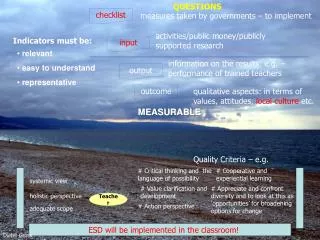
QUESTIONS checklist measures taken by governments – to implement e.g. is there a ‘public awareness’ component in relevant national documents that address ESD? activities/public money/publicly supported research Indicators must be: input e.g. in what subjects are SD themesintegrated? • relevant • easy to understand • representative information on the results: e.g. – performance of trained teachers output e.g. are there quality criteria for ESD-related teaching materials? outcome qualitative aspects: in terms of values, attitudes, local culture etc. e.g.do educational institutions/organizations participate in international networks? MEASURABLE INDICATORSFOR ESD instead of numerous Less INDICATORS Guidelines in the classroom: Quality Criteria – e.g. # Critical thinking and the language of possibility # Cooperative and experiential learning systemic view # Value clarification and development # Appreciate and confrontdiversity and to look at this as ‘opportunities’ for broadening options for change holistic perspective Teacher # Action perspective adequate scope ESD will be implemented in the classroom! Dieter Gross
References: “Quality Criteria for ESD-Schools” Guidelines to enhance the quality of Education for Sustainable Development May 2005, ISBN 3-85031-048-5 Authors: Breiting, Søren; Mayer, Michela; Mogensen, Finn; Editor: Austrian Federal Ministry of Education, Science and Culture, Dept. V/11c, Environmental Education Affairs Funded by the European Commission in the frame of the EU-COMENIUS 3 network “School Development through Environmental Education” (SEED) Projectnumber: 100530-CP1-2002-1-AT-COMENIUS-C3 In collaboration with the international network “Environment and School Initiatives” (ENSI) ECONOMIC COMMISSION FOR EUROPE COMMITTEE ON ENVIRONMENTAL POLICY UNECE Steering Committee on Education for Sustainable Development CEP/AC.13/2005/9 First meeting: Geneva, 13 to14 December 2005 INDICATORS FOR EDUCATION FOR SUSTAINABLE DEVELOPMENT progress report on the work of the Expert Group, chaired by Mr. Roel van Raaij (the Netherlands). Gross, Dieter (1997): A Curriculum Based on the Principle of Sustainable Development 4th European Congress for Environmental Education, AUDES Association of University Departments of Environmental Sciences in Europe: Multidisciplinarity and International Co-operation in Environmental Education, Chambéry http://www.desd.sustain-future.org/chambery.pdf