Essential Guidelines for Effective Teaching and Knowledge Sharing in Islam
This guide highlights essential do's and don'ts for educators and students aiming to promote Islamic knowledge effectively. It emphasizes the importance of pure intentions for Allah's pleasure, attentiveness in learning, and the significance of sharing knowledge with humility and kindness. Educators are encouraged to follow the examples of the Sahaba, while being mindful of students' needs and levels to avoid distractions and boredom. Ultimately, self-improvement and proper dissemination of knowledge are foundational for those seeking to teach and learn in the path of Islam.

Essential Guidelines for Effective Teaching and Knowledge Sharing in Islam
E N D
Presentation Transcript
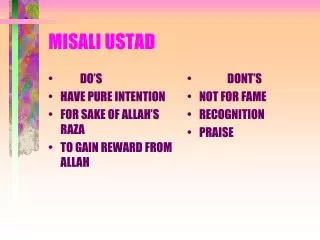
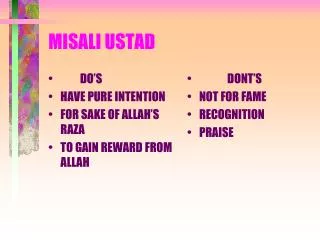
DO’S HAVE PURE INTENTION FOR SAKE OF ALLAH’S RAZA TO GAIN REWARD FROM ALLAH DONT’S NOT FOR FAME RECOGNITION PRAISE MISALI USTAD
DO’S FOLLOW SAHABA’S EXAMPLE BE ATTENTIVE LISTEN CAREFULLY UNDERSTAND ABSORB TAKE NOTES DON’T’S BE EASILY DISTRACTED BE INATTENTIVE BE CASUAL BE A MISALI TALIB-E-ILM
DO’S SHARE WITH FAMILY, FRIENDS BENEFIT: PRESERVATION OF KNOWLEDGE PRACTICE WHAT YOU PREACH DON’T’S HAVE SHALLOW KNOWLEDGE PASS INCORRECT INFO KEEP KNOWLEDGE TO SELF NOT ACT ON IT SHARE THE KNOWLEDGE
DO’S BE HUMBLE POLITE KIND FIRM DON’T’S BE ARROGANT IMPOLITE HARSH COMPROMISE ON RULES BE NAASIH ( KHAIRKHWAH)
WORK ON SELF IMPROVEMENT OVER ZEALOUS ABOUT SHARING BUT NO EFFORT ON SELF IMPROVEMENT RECOGNISE STRENGTHS AND WEAKNESSES
DO’S TEACH AT THEIR LEVEL USE EASY LANGUAGE DELIVER SKILLFULLY DONT’S IGNORE LEVEL OF STUDENTS BORE STUDENTS RECOGNISE NEEDS OF STUDENTS