The Legacy of Shakespeare: The Greatest Writer in English Literature
390 likes | 495 Vues
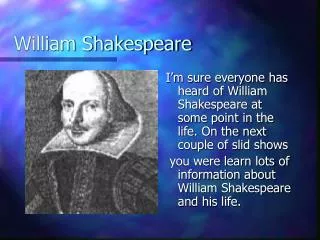
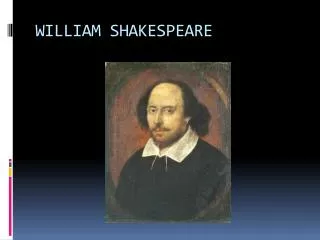
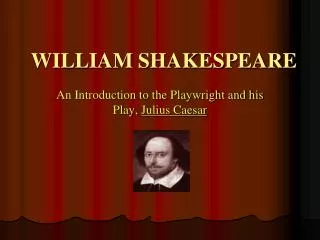
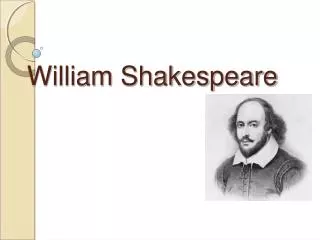
William Shakespeare, born in 1564 in Stratford-upon-Avon, is celebrated as the greatest writer in English literature. He authored 37 plays and approximately 154 sonnets, and began his career as an actor with the Lord Chamberlain’s Men. The Globe Theatre, constructed in 1599, was where many of his works were performed. Shakespeare's influential plays encompass comedies, histories, and tragedies, incorporating rich language, intricate plots, and a variety of character dynamics. His innovative storytelling continues to resonate, showcasing themes of love, conflict, and the human spirit.


The Legacy of Shakespeare: The Greatest Writer in English Literature
E N D
Presentation Transcript
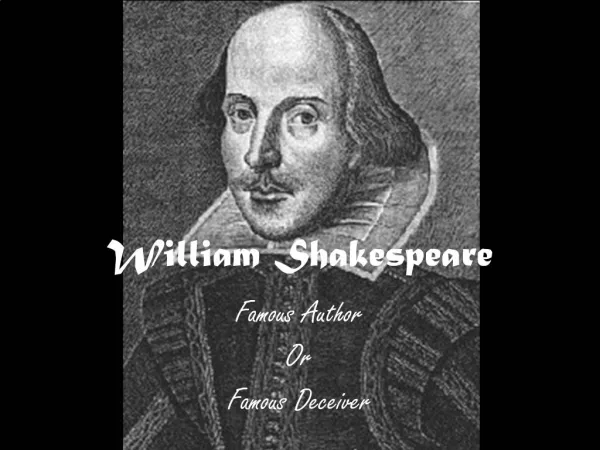
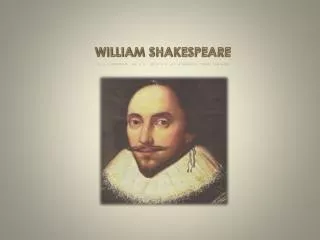
William Shakespeare Widely regarded as the greatest writer in English Literature
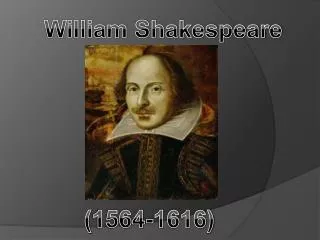
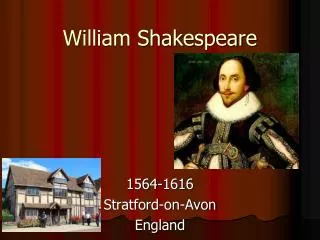
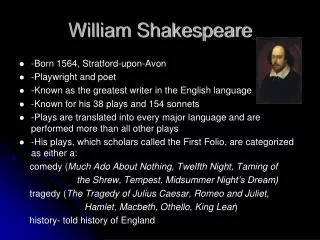
Shakespeare • 1563-1616 • Stratford-on-Avon, England • wrote 37 plays • about 154 sonnets • started out as an actor
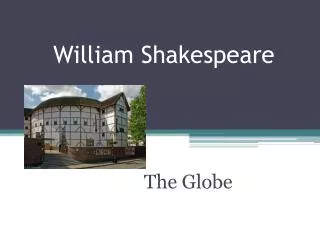
Stage Celebrity • Actor for Lord Chamberlain’s Men (London Theater Co.) • He was the principal playwright for them • 1599: Lord Ch. Co. built the Globe Theater where most of Shakespeare’s plays were performed
Shakespeare wrote: • Comedies • Histories • Tragedies
The Theater • Plays produced for the general public • Roofless--open air • No artificial lighting • Courtyard surrounded by 3 levels of galleries
Spectators • Wealthy got benches • “Groundlings”>poorer people stood and watched from the courtyard (“pit”) • All but wealthy were uneducated/illiterate • Much more interaction than today
Staging Areas • Stage: platform that extended into the pit • Dressing & storage rooms in galleries behind & above stage • second-level gallery; upper stage; famous balcony scene in R & J
Differences • No scenery • Settings > references in dialogue • Elaborate costumes • Plenty of props • Fast-paced, colorful>2 hours!
Actors • Only men and boys • Young boys whose voices had not changed played women’s roles • Would have been considered indecent for a woman to appear on stage
Elizabethan (QE1) Words • An,and: If • Anon: Soon • Aye: Yes • But: Except for • E’en: Even • E’er: Ever
QE1 Words (contin.) • Haply: Perhaps • Happy: Fortunate • Hence: Away, from her • Hie: Hurry • Marry: Indeed
QE1 Words (contin.) • Whence: Where • Wilt: Will, will you • Withal: In addition to • Would: Wish
Prose • Ordinary writing that is not poetry, drama, or song • Only characters in the lower social classes speak this way in Shakespeare’s plays • Why?
Plot • The sequence of events in a literary work
Exposition • The plot usually introduces: • setting • characters • basic situation
Inciting Moment • Often called “initial incident” • the first bit of action that occurs which begins the plot
Rising Action • Action that leads up to the climax • This is where the story gets exciting!
Conflict • The struggle that develops • man vs. man • man vs. himself • man vs. society • man vs. nature
Crisis • The point where the protagonist’s situation will either get better or worse • Protagonist-good guy • Antagonist-bad guy
Climax • The turning point of the story…everything begins to unravel from here • begins the falling action
Falling Action • This takes place after the climax, but before the resolution
Resolution • The end of the central conflict
Denouement • The final explanation or outcome of the plot • If this is included in literature, it will occur after the resolution.
Tragedy (Shakespearean) • Drama where the central character/s suffer disaster/great misfortune • In many tragedies, downfall results from: • Fate • Character flaw/fatal flaw • Combination of the two
Theme • Central idea or • Insight about life which explains the downfall
Dramatic Foil • A character whose purpose is to show off another character
Round Characters • Characters who have many personality traits, like real people.
Flat Characters • One-dimensional, embodying only a single trait • Shakespeare often uses them to provide comic relief even in a tragedy
Static Characters • Characters within a story who remain the same. They do not change. They do not change their minds, opinions or character.
Dynamic Character • Characters that change somehow during the course of the plot. They generally change for the better.
Monologue • One person speaking on stage (there may be other character on stage, too)
Soliloquy • Long speech expressing the thoughts of a character alone on stage.
Aside • Words spoken, usually in an undertone, not intended to be heard by all characters
Pun • Shakespeare loved to use them!!! • Humorous use of a word with two meanings; this is sometimes missed by the reader because of Elizabethan language and other innuendos
Direct Address • Words that tell the reader who is being addressed: • “A right fair mark, fair coz, is soonest hit.” • “Ah, my mistresses, which of you all/ Will now deny to dance?”
Dramatic Irony • A contradiction between what a character thinks and what the reader/audience knows to be true
Verbal Irony • Words used to suggest the opposite of what is meant
Situational Irony • An event occurs that directly contradicts the expectations of the characters, the reader, or the audience
Comic Relief • Use of comedy within literature that is NOT comedy to provide “relief” from seriousness or sadness.