
Enhancing Response to Aerosolized Anthrax Attacks: A Bioweapon Containment Strategy
This research focuses on improving decision-making and response times following aerosolized anthrax attacks in the DC metropolitan area. By examining current surveillance methods and response protocols, we aim to identify weaknesses and propose enhancements in communication and procedure. Our study incorporates various methodologies including interviews and simulations to develop a robust framework for interaction among agencies involved in bioweapon response. Ultimately, our goal is to mitigate casualties and streamline processes during such critical incidents.

Enhancing Response to Aerosolized Anthrax Attacks: A Bioweapon Containment Strategy
E N D
Presentation Transcript
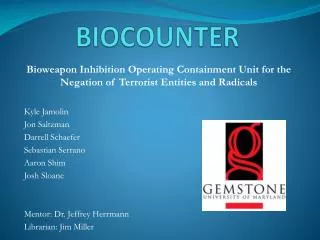
BIOCOUNTER Bioweapon Inhibition Operating Containment Unit for the Negation of Terrorist Entities and Radicals Kyle Jamolin Jon Saltzman Darrell Schaefer Sebastian Serrano Aaron Shim Josh Sloane Mentor: Dr. Jeffrey Herrmann Librarian: Jim Miller
Overview • Research Problem • Purpose and Hypothesis • Literature Review • Methodology • Conclusion • Timeline/Budget BIOCOUNTER
Research Problem • Problem: ambiguity and disorganization after aerosolized anthrax release • Question: What are the problems after an attack?: - Surveillance - Investigation - Determining response - Executing response BIOCOUNTER
Purpose • Purpose of our research: To determine ways to improve the investigation and decision making of the response to an aerosolized anthrax attack in the DC metropolitan area • Hypothesis: We will figure out improvements to procedures and communication between organizations that, if implemented, would decrease response time and casualties in event of anthrax exposure. BIOCOUNTER
Literature Review • Surveillance - BioWatch: technological detection - BioSense: syndromic surveillance, hospital reports, pharmaceutical purchases • Response - Cities Readiness Initiative: prophylaxis campaign - National Response Plan - Kansas Department of Health study BIOCOUNTER
Soft Systems Methodology BIOCOUNTER
Methodology • IRB Interviews, documents, publications • Models of Interactions • Simulations and Recommendations BIOCOUNTER
Conclusion • Importance of study - to reduce response time and mitigate casualties - develop framework of the interactions for future studies • Project Limitations? - networking connections - classified documents, etc - SSM timeframe BIOCOUNTER
Timeline Spring 2012: • Models of interaction and comparison with rich pictures • Write first three chapters of thesis (Introduction, Literature Review, and Methodology) • Finalize interviews • Feasible and desirable changes- continue and finalize simulations • Fall 2012: • Finalize feasible and desirable changes • Continue to work on thesis • Finalize list of experts for thesis conference and submit list to Gemstone Spring 2013: • Action to improve problem situation • Continue to work on thesis • Attend thesis conference • Pursue journal publication Spring 2011: • Describe the problem and form rich pictures • Present final thesis proposal to committee after having it reviewed by librarian • Finalize questions to ask and conclude what information is required from experts • Determination and application of IRB Human Subject Research • Design team website • Determine additional journal subscriptions we needed, conferences to attend, and possible need for additional funding • Apply for grants Fall 2011: • Rich pictures • Root definition • Form models of interaction and use them in interviews • Outline our final thesis • Attend appropriate conferences • Begin simulation studies • Conduct interviews BIOCOUNTER
Budget • Additional Publication Subscriptions $150 • Conference Costs (4 total, 2 members attending each) - transportation $2,050 - hotel/accommodations $2,050 - attendance $3,300 - books/publications $400 • Transportation money to governmental and emergency facilities $200 Total cost: $8,150 *currently seeking grants through the Robert Woods Johnson Foundation and the ACCIAC Fellows Program BIOCOUNTER
Questions? BIOCOUNTER