20 th century cosmology
180 likes | 311 Vues
This overview traces the critical developments in cosmology from the 1920s to the 1990s, highlighting key milestones such as Hubble's Law, the birth of observational cosmology, and the profound implications of the Cosmic Microwave Background (CMB) discovery. It examines the theoretical technology that preceded significant data collection and explores the emergence of astrophysical models like the Hot Big Bang. Key findings, including COBE's contributions to understanding CMB anisotropies, laid the groundwork for modern precision cosmology and reshaped our understanding of the universe's origins.


20 th century cosmology
E N D
Presentation Transcript
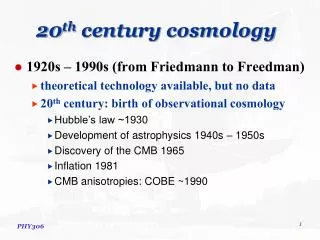
20th century cosmology • 1920s – 1990s (from Friedmann to Freedman) • theoretical technology available, but no data • 20th century: birth of observational cosmology • Hubble’s law ~1930 • Development of astrophysics 1940s – 1950s • Discovery of the CMB 1965 • Inflation 1981 • CMB anisotropies: COBE ~1990 PHY306
20th century cosmology • 1920s – 1990s (from Friedmann to Freedman) • theoretical technology available, but no data • 20th century: birth of observational cosmology • Hubble’s law ~1930 • Development of astrophysics 1940s – 1950s • Discovery of the CMB 1965 • “smoking gun” for the Hot Big Bang model • now the main tool for precision cosmology (see later) PHY306
The Cosmic Microwave Background: Theory • Prediction of CMB trivial in Hot Big Bang model • hot, ionised initial state should produce thermal radiation • photons decouple when universe stops being ionised (last scattering) • expansion by factor a cools ablackbody spectrum from T to T/a • therefore we should now seea cool blackbody background • Alpher and Herman, 1949,“a temperature now of the orderof 5 K” • Dicke et al., 1965, “<40 K” • note that the Alpher andHerman prediction had beencompletely forgotten at this time! PHY306
The Cosmic Microwave Background: Theory • Blackbody background radiation is a natural consequence of the whole universe having been in thermal equilibrium at one particular past time • Continuous creation of radiation does not lead to a blackbody background • see photons from different distances, created at different times, with different redshifts • superposition of several blackbody spectra with different temperatures is not a blackbody PHY306
The Cosmic Microwave Background: Observations • First seen in 1941 (yes, 1941) • lines seen in stellar spectra identified as interstellar CH and CN (Andrew McKellar, theory; Walter Adams, spectroscopy) • comparison of lines from different rotational statesgave “rotational temperature” of 2-3 K • unfortunately Gamow et al. do not seem to have known about this CH CN spectrum of ζ Oph, Mt Wilson coudé spec., Adams 1941 PHY306
The Cosmic Microwave Background: Observations • Discovered in 1965 • Penzias and Wilson observe excess “antenna temperature” of 3.5±1.0 K from the Holmdel microwave horn • interpreted by Dicke et al. at Princeton • they had independentlyrediscovered the pre-diction and were just about to start looking forthe radiation! • note: this is one point (nota blackbody spectrum!) PHY306
The Cosmic Microwave Background: Spectrum Roll and Wilkinson, 1966: a second pointBoynton, Stokes and Wilkinson, 1968Thaddeus, review 1972Muehler and Weiss,1973: first indicationsof radiation beyond thepeak of the spectrum PHY306
The Cosmic Microwave Background: Spectrum • Is the spectrum a blackbody? • Balloon measurements by Woody and Richards (1981) – no! • higher temperature than the long wavelength measurements • spectrum more peaked • much theoretical interest, but data were simply wrong • CN measurements by Meyer and Jura, 1985 • temperature back to 2.74 K (not 2.96) • no evidence for non-blackbody PHY306
COBE • Launched November 1989 • After two years of data: • spectrum is a precise blackbody (no measurable deviations) • T = 2.725±0.002 K • At this point all cosmological models other than Hot Big Bang are effectively dead • no other model expects this good a blackbody background Mather et al., ApJ354(1990) L37 9 minutes of data!! PHY306
CMB Structure • COBE saw: • a dipole anisotropy of 0.1% • we are moving relative to the CMB rest frame • random anisotropies of ~10−5 • these represent density fluctuations in the early universe • COBE’s angular resolution was not good, so it mapped only very large-scale fluctuations (~10°) • superclusters, not galaxies • revisit this later in the course PHY306
Observations & the Hot Big Bang • Predictions of Hot Big Bang model ~mid 1960s • background radiation (“smoking gun”) • discovered by accident in 1965, but about to be found on purpose! • age of universe ≤ 1/H0 • reasonably OK by this time • discovery of quasars helpedestablish evolution • primordial deuterium andhelium abundance • calculated by Jim Peebles, 1966 • Really a set of models, so need to measure parameters PHY306
Big Bang Nucleosynthesis • First detailed calculations by Wagoner, Fowler and Hoyle • Basic principles • at very high energies neutrons and protons interconvert: p + e− ↔ n + ν • neutron:proton ratio given by exp(−Δmc2/kT) where Δm is the neutron-proton mass difference and T is the temperature at which the neutrinos “freeze out” (~1010 K) • this is ~1:5 Wagoner, Fowler, Hoyle, ApJ 147 (1967) 3 PHY306
Big Bang Nucleosynthesis • As universe cools, start fusion reactions • p + n ↔ d + γ • deuterium starts to build up below T~109 K • background photons are no longer energetic enough for back reaction • d + p → 3He + γd + n → 3H + γd + d → 3H + p or 3He + n • various reactions then lead to 4He (and a bit of 7Li) • eventually every neutron winds up in 4He • 4He fraction ~1:8 by number, 1:2 by mass • actually rather less because some neutrons decay Wagoner, Fowler, Hoyle, ApJ 147 (1967) 3 PHY306
Big Bang Nucleosynthesis • Final yields of 2H, 3He, 4He and 7Li depend on • the neutron lifetime (measured in lab) • 885.7±0.8 s (PDG, 2004) • the number of neutrino species (measured in e+e−) • because in radiation dominated era H2 ρrel = ργ + Nνρν • 2.984±0.008 (combined LEP experiments) • H (measured by HST, WMAP) • 72±8 km/s/Mpc (HST), 70.1±1.3 km/s/Mpc (WMAP) • baryon density (i.e. number density of protons+neutrons) PHY306
Light elements: observations • Helium 4 • measure in spectra of Pop. II stars • also produced in stars: big correction factors • Helium 3 • measured in radio (spin flip of 3He+ at 3.46 cm) • Deuterium • lines can be separated from 1H • currently best measured isotope • Lithium 7 • measure in spectra • also produced by cosmic rays, and destroyed by stars • results are currently not concordant Bania et al., ApJSS113 (1997) 353 Linsky, Sp. Sci. Rev. 106 (2003) 49 PHY306
Big Bang Nucleosynthesis • Current abundances Fields and Sarkar, PDG 2008 • D/H = (2.84±0.26) × 10−5 • 7Li/H = (1.23±0.06) × 10−10 • but could be factor of 2 higher • Y = 0.249±0.009 • 3He is only measured in our Galaxy – systematics too high to be useful • 7Li somewhat inconsistent • but may be destroyed in the early universe or in stars • D/H is consistent with WMAP Ωb PHY306
Case for the Hot Big Bang • The Cosmic Microwave Background has an isotropic blackbody spectrum • it is extremely difficult to generate a blackbody background in other models • The observed abundances of the light isotopes are reasonably consistent with predictions • again, a hot initial state is the natural way to generate these • Many astrophysical populations (e.g. quasars) show strong evolution with redshift • this certainly argues against any Steady State models PHY306
Outstanding Problems • Why is the CMB so isotropic? • horizon distance at last scattering << horizon distance now • why would causally disconnected regions have the same temperature to 1 part in 105? • Why is universe so flat? • if Ω≠ 1, Ω evolves rapidly away from 1 in radiation or matter dominated universe • but CMB analysis (later!) shows Ω = 1 to high accuracy – so either Ω≡ 1 (why?) or Ω is fine tuned to very nearly 1 • How do structures form? • if early universe is so very nearly uniform → inflation PHY306