10.5 Equilibria in Salt Solutions
40 likes | 193 Vues
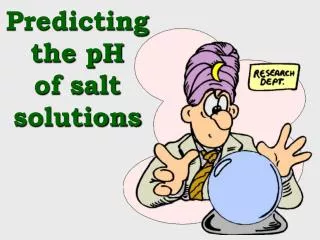
This guide explores how the pH of various salt solutions is determined by their acidic and basic constituents. It covers the dissociation of Sodium Ethanoate, a salt derived from a weak acid and a strong base, leading to a pH greater than 7. Conversely, Ammonium Chloride, stemming from a strong acid and a weak base, results in a pH less than 7 upon dissociation. Lastly, Sodium Chloride, composed of strong acid and base, yields a neutral pH of 7. Understanding these concepts is crucial for chemistry studies and practical applications in various fields.


10.5 Equilibria in Salt Solutions
E N D
Presentation Transcript
10.5 Equilibria in Salt Solutions LO: I understand how the pH of a salt solution comes about.
weak Sodium ethanoate is the salt of a acid and a base. strong Sodium ethanoate completely splits into when dissolved in water: ions The pH of sodium ethanoate is . CH3COO-Na+(s) + water CH3COO-(aq) + Na+(aq) + H2O(l) H+(aq) + OH-(aq) CH3COOH(aq) >7 LO: I understand how the pH of a salt solution comes about.
strong Ammonium chloride is the salt of a acid and a base. weak Ammonium chloride also completely splits into . when dissolved in water: ions The pH of ammonium chloride is . NH4+Cl-(s) + water NH4+(aq) + Cl-(aq) + H2O(l) OH-(aq) + H+(aq) NH3(aq) + H2O(l) <7 LO: I understand how the pH of a salt solution comes about.
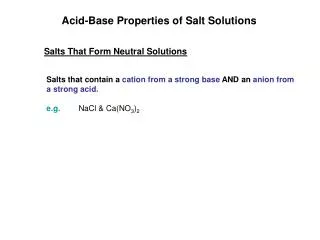
strong Sodium chloride is the salt of a acid and a base. strong The pH of sodium chloride is . Na+Cl-(s) + water Na+(aq) + Cl-(aq) Neither ion is involved in an equilibrium. 7 LO: I understand how the pH of a salt solution comes about.