RENAL DIALYSIS
RENAL DIALYSIS. And Hormone Replacement Therapy. Dot Point . “ Compare the process of renal dialysis with the function of the kidney”. What is Renal Dialysis?. People with dysfunctional kidneys are not able to remove wastes such as urea

RENAL DIALYSIS
E N D
Presentation Transcript
RENAL DIALYSIS And Hormone Replacement Therapy
Dot Point “ Compare the process of renal dialysis with the function of the kidney”
What is Renal Dialysis? • People with dysfunctional kidneys are not able to remove wastes such as urea • They have to undergo renal dialysis to regulate their blood
The Two Forms Of Dialysis Are: • Haemodialysis: And • Peritoneal Dialysis:
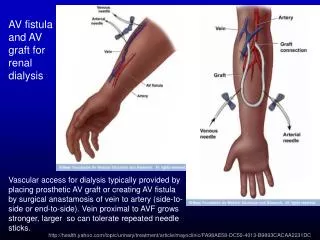
Haemodialysis • Occurs outside of the body • The blood is extracted from a vein and passed into a dialyser, which is a bundle of hollow fibres made of a semi-permeable membrane • The dialyser contains a solution of dialysing fluid, which has similar ion concentrations to blood • The dialyser only allows wastes to pass through, and not blood cells and proteins. In this way it is similar to the filtrations stage of the nephron.
Haemodialysis • The wastes diffuse into the solution, and it is constantly replaced • The anti-clotting agent, heparin, is also added to prevent clotting • The blood is then returned to the body
Peritoneal Dialysis • This occurs in the body • Dialysis solution is introduced into the peritoneal (abdominal) cavity through a catheter • The lining of the peritoneal cavity is a natural semi-permeable membrane and has its own rich blood supply • The wastes diffuse into the solution, which is replaced.
“Outline the general use of hormone replacement therapy in people who cannot secrete aldosterone:” • The adrenal gland secretes aldosterone, without which the body would not be able to regulate salt and water concentrations (problems = dehydration etc) • Artificial hormones (e.g. fludrocortisone ) can be used as a treatment for people who cannot secrete aldosterone (due to a damaged adrenal gland; Addison’s disease).