Advanced Simulation of Microsystems Using SUGAR 2.0: Genetic Algorithms and Optimization Techniques
The SUGAR 2.0 beta program is a powerful simulation tool for microsystems, enabling users to extend model functions and utilize parameterized netlists. With applications in genetic algorithms and adaptive modeling, recent work involves transient analysis of needle piercing through pig skin. Key results from simulations illustrate the pull-in behavior with nonlinear oscillations at varying voltage levels. SUGAR shows high accuracy, achieving within 0.5% of experimental results related to serpentine stiffness and actuator optimization, paving the way for future enhancements in microelectromechanical systems.

Advanced Simulation of Microsystems Using SUGAR 2.0: Genetic Algorithms and Optimization Techniques
E N D
Presentation Transcript
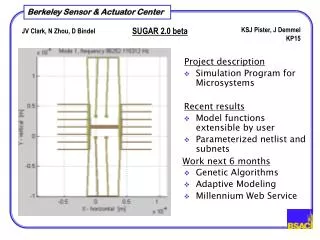
SUGAR 2.0 beta KSJ Pister, J Demmel KP15 JV Clark, N Zhou, D Bindel Project description • Simulation Program for Microsystems • Model functions extensible by user • Parameterized netlist and subnets • Genetic Algorithms • Adaptive Modeling • Millennium Web Service Recent results Needle piercing pig skin Work next 6 months
Transient Analysis of Pull-In Smooth ramp V(t) = 0V to 20V. Pulls in at about 2/3 of gap. Stepped ramp V(t) = 11V to 15V. Nonlinear oscillation before pull-in.
Subnets used for serpentines La,b w=1.8u SUGAR 3032Hz FEA 3032Hz Experimental 2697Hz * * * No damping was used in FEA and SUGAR simulations.
Serpentine Parameterization Level curves of serpentine stiffness Dependence on DL & Dw K=0.0013N/m Within 1.2% of experimental Measured by Fedder DL K=0.0146N/m K=0.27N/m Dw
w DY gap T=150C T=600C Heatuator Optimization This geometry was given by B. Allen [Hilton Head ‘98]. SUGAR comes within 0.5% of experimental. However, this geometry can be optimized for maximum deflection with SUGAR.
Heatuator Optimization Deflection dependence on Dgap & Dw DY Within 0.5% error Measured by B. Allen et al. Dw Dgap