

SlideServe
Menu
Préférences
© SlideServe · v2026

Tandem Learning

lorand avatar
5 diapositives · 470 Views · Oct 15, 2014

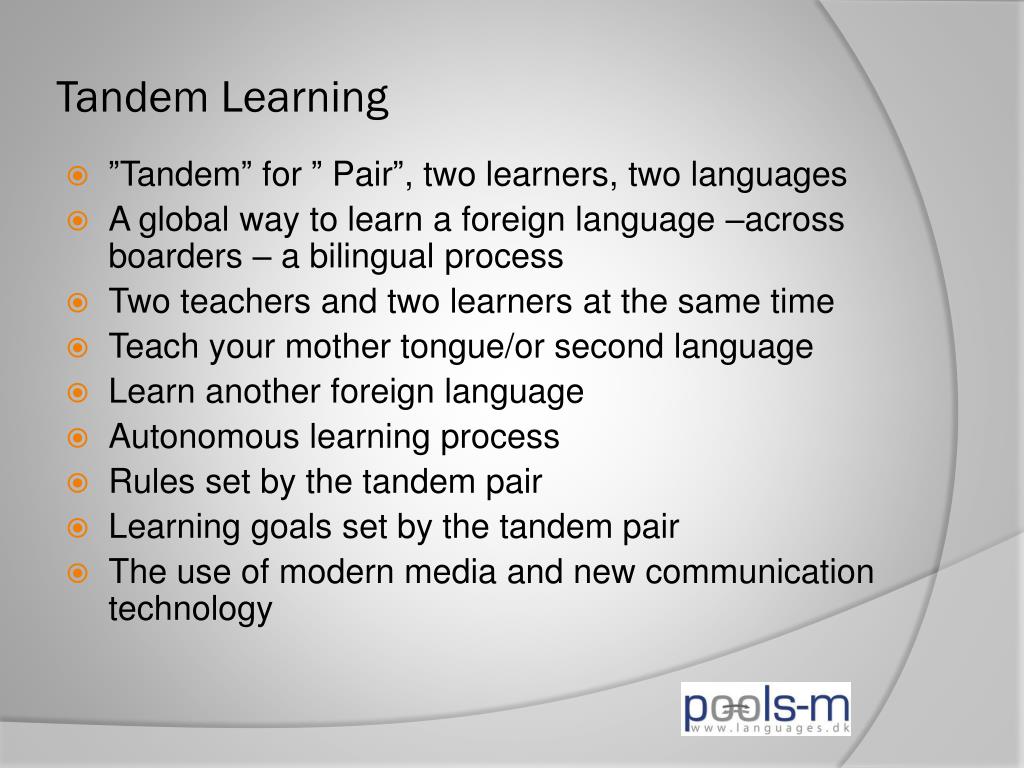
Tandem Learning. ” Tandem ” for ” Pair ” , two learners, two languages A global way to learn a foreign language –across boarders – a bilingual process Two teachers and two learners at the same time Teach your mother tongue/or second language Learn another foreign language
Tandem Learning - slide 1
01 / 5Tandem Learning
1 / 17

Télécharger la présentation

Tandem Learning
Une image / un lien ci-dessous est fourni (tel quel) pour télécharger la présentation

Politique de téléchargement : le contenu du site vous est fourni TEL QUEL pour votre information et votre usage personnel ; il ne peut être vendu, concédé sous licence ni partagé sur d’autres sites sans l’accord de son auteur.Le contenu vous est fourni TEL QUEL, pour votre information et votre usage personnel uniquement. Téléchargez la présentation en cliquant sur ce lien. Lors du téléchargement, si vous ne parvenez pas à télécharger une présentation, l’éditeur a peut-être supprimé le fichier de son serveur.Pendant le téléchargement, si vous ne parvenez pas à obtenir une présentation, le fichier a peut-être été supprimé par l’éditeur.

F I N

Plus de contenu associé

Transcription de la présentation
  1. Tandem Learning • ”Tandem” for ” Pair”, two learners, two languages • A global way to learn a foreign language –across boarders – a bilingual process • Two teachers and two learners at the same time • Teach your mother tongue/or second language • Learn another foreign language • Autonomous learning process • Rules set by the tandem pair • Learning goals set by the tandem pair • The use of modern media and new communication technology

  2. What do you need? • Two teachers (students) • Two learners ( same students) • To choose a media (email, LMS system, facebook, telephone, video conference etc.) • To set up a framework and structure for the tandem work • A common subject to talk about – chosen by the tandem pair • Learning goals set by the tandem pair

  3. What do you need ….? • Syncronousorasyncronous • To choose the level • To choose the work load • To choose a commonlanguage for feed back • To beaware of all elements of languagelearning:reading, writing, listening and speaking • Courage

  4. Benefits • Student motivation • Autonomous learning process • Flexible • Individuals goals • Different levels? Yes • Accreditation? Yes, of course • Competence based? Definately • video

  5. ”My mother” An example • Level: beginner • Media: e-mail and attached voice recordings and text files • Maximum 10 sentences by mail • A recording of the sentences • A translation of the ten sentences ( only used if necessary) • Structure: • T1 sends to T2(student). Text, recording and translation. • T2 tries to read, listen and understand. Asks questions to T1 (mail). • T2 practices the written sentences, listens to the recording and records own pronounciation to send to T1. T1 will give feed back. • T2 writes to T1 about the same subject in the foreign language, records new sentences – feed back from T1. • The process reverses – T2 writes in mother tongue to T1 about the same subject.