Measurement
The Metric System is a global standard for measurements, utilizing units like meters (m), grams (g), and liters (L). In contrast, the United States primarily employs the English System, which features units such as yards, pounds, and gallons. It’s crucial to remember that every measurement must include a unit. Prefixes like kilo, centi, and milli help define different magnitudes. This guide covers basic unit conversions and fundamental measurement concepts including volume and density, essential for both scientific and everyday applications.

Measurement
E N D
Presentation Transcript
The Metric System is a system of measurements and units used all over the world. • United States uses the English System. • A standard is an exact quantity that people agree to use for comparison.
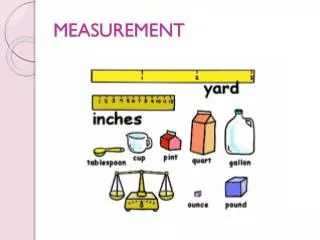
Metric English • meter (m) • gram (g) • Liter (L) • yard, inch, feet, mile (yd, in, ft, mi) • pounds, ounces (lbs, oz) • fluid ounces, gallon, pint (fl oz, gal, pt)
Measurements… • Must have UNITS !!!! • ALL numbers MUST have units! • Unit examples: m, cm, g, L, ft, yd
In the metric system, we will use the following units: • Liquid Liters (L) • mass grams (g) • length meters (m) • temperature Celsius ( ºC) • time seconds (s)
Units for other common measurements Density: g/cm3 Velocity: m/s Acceleration: m/s2 Force: Newton Energy: Joule Power: Watts Volume: cm3
Prefixes are used to determine differences in sizes. • Examples: • kilo = 1000 • centi = 1/100th • milli = 1/1000th
Other Examples… • The prefix goes with the base unit. • kilo + meter = km = 1000 meters • centi + meter = cm = 1/100 meters • hecto + meter = hm = 100 meters
kilo hecto km hm Dm m 1000 dm 100 cm 10 mm 1 0.1 0.01 0.001 Deka unit deci centi milli
Converting numbers • To convert to a smaller unit, move the decimal point to the right or multiply. • To convert to a larger unit, move the decimal point to the left or divide.
king k kilo • henry h hecto • Died D deka • unexpectedly u unit • drinking d deci • chocolate c centi • milk m milli
Example Conversions • 1000 mg = __________ g • 160 cm = __________ mm • 109 g = ___________ kg • 1 L = ____________ mL • 14 km = ___________ m • 250 m = ____________ km
Volume Volume is the amount of space occupied by an object. To find the volume of a solid rectangle, you measure L x W x H To measure volume of liquid, we use graduated cylinders or other containers marked for measuring.
Density Density is the mass per unit volume of material. You find density by dividing an object’s mass by the object’s volume. D=m/v