
Mitochondria
E N D
Presentation Transcript
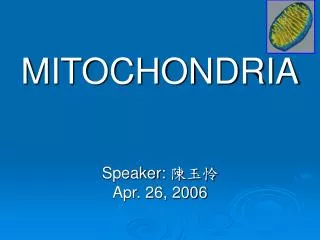
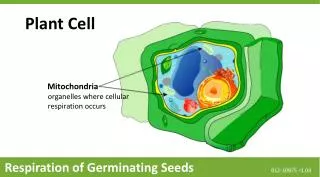
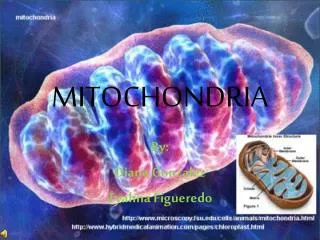
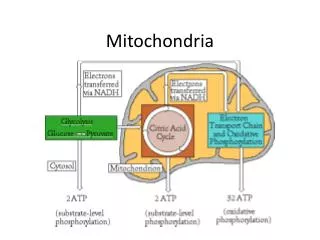
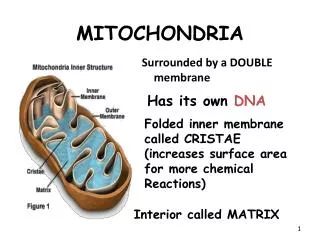
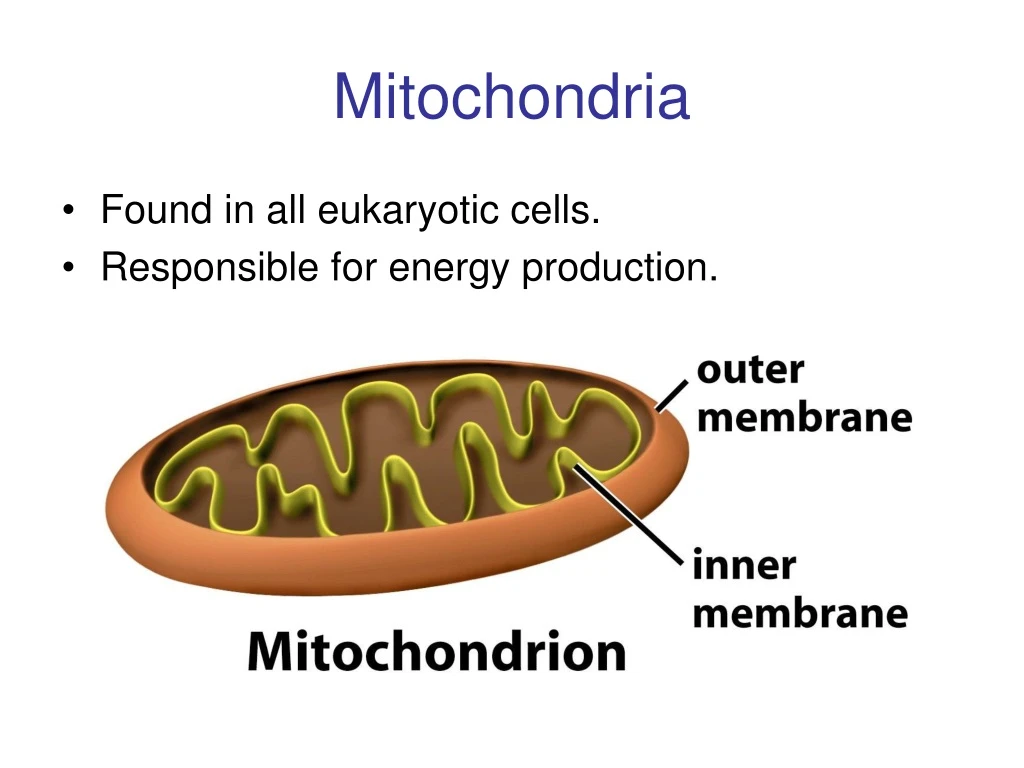
Mitochondria • Found in all eukaryotic cells. • Responsible for energy production.
Chloroplasts • Found only in eukaryotic cells such as plants and algae. • Site of photosynthesis.
Cytoskeleton • Made of long, thin, protein filaments. • Three sizes • Microfilaments • Intermediate filaments • Microtubules • Provides internal cell structure. • Anchor and connect organelles. • Move parts and products.
Plasma Membrane • Fluid mosaics of phospholipids, proteins and carbohydrates.
Plasma Membrane • Phospholipids provide basic architecture. • Have hydrophilic tails and hydrophobic heads.
Plasma Membrane • Proteins act as channels, recognition molecules, carrier proteins, etc. • Carbohydrates help connect cells and play a role in identification.
Diffusion • Net movement of molecules from areas of high concentration to areas of low concentration. • No energy required.
Diffusion Double click the image to play movie
Osmosis • Type of diffusion. • Movement of water across semipermeable membrane from area of high water concentration to area of low water concentration.
Effect of osmosis on cells in various solutions • Hypotonic solutions • High concentration of water in extracellular fluid compared to inside the cells causes net movement of water into the cell. • Results in increased cell size. • Can cause cell to burst.
Effect of osmosis on cells in various solutions • Isotonic solutions • Concentrations of water inside and outside of the cell are equal. • Results in no net movement of water. • Cell size remains the same.
Effect of osmosis on cells in various solutions • Hypertonic solutions • Concentration of water in cell exceeds that outside of cell. • Results in net movement of water out of the cell. • Cell shrinks.
Membrane transport • Large or hydrophilic substance cannot pass freely through the membrane. • To move them through the membrane, must have channel proteins or carrier proteins.
Passive Transport: Ion Channels • Ions are hydrophilic and the channel must be open for the ion to pass through the channel. • Selective for each ion. • Ion moves down concentration gradient.
Passive Transport: Facilitated diffusion • Molecule enters protein carrier. • Induces protein shape change allowing molecule to exit the carrier.
Passive Transport: Facilitated diffusion • Selective for each molecule. • Molecule moves down concentration gradient.
Passive Transport: Facilitated diffusion Double click the image to view movie
Active Transport • Uses carrier protein. • Moves molecules against their concentration gradient. • Requires ATP as an energy source.
Active Transport Double click the image to view movie
Endocytosis • Cells absorb outside material by inverting plasma membrane to form a vesicle that encases the material.
Exocytosis • Moving molecules, particles, and other substances contained in vesicles across the plasma membrane and out of the cell.