Download
1 / 10
110 likes | 226 Vues
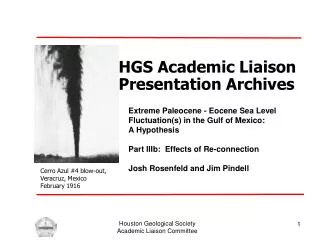
This presentation explores the hypothesis regarding extreme sea level fluctuations during the Paleocene-Eocene era in the Gulf of Mexico, focusing on the effects of re-connection. The analysis features seismic data lines SF-6B and SF-17, sourced from Marton and Buffler (1999), examining geological formations and their implications on current Mediterranean bathymetry. This research highlights crucial geological events, such as the Cerro Azul blowout in Veracruz (February 1916), contributing to the broader understanding of geological dynamics in historical contexts.

E N D
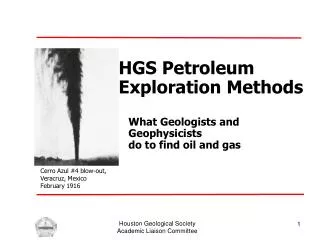
HGS Academic Liaison Presentation Archives Extreme Paleocene - Eocene Sea Level Fluctuation(s) in the Gulf of Mexico: A Hypothesis Part IIIb: Effects of Re-connection Josh Rosenfeld and Jim Pindell Cerro Azul #4 blow-out, Veracruz, Mexico February 1916 Houston Geological Society Academic Liaison Committee
Seismic Line SF-6B From Marton and Buffler, 1999 Houston Geological Society Academic Liaison Committee
Seismic Line SF-6B From Marton and Buffler, 1999 Houston Geological Society Academic Liaison Committee
Houston Geological Society Academic Liaison Committee
Seismic Line SF-17 From Marton and Buffler, 1999 Houston Geological Society Academic Liaison Committee
Present day Mediterranean bathymetry From AAPG Explorer, V. 24, #3, 2003, p.40 Houston Geological Society Academic Liaison Committee
Houston Geological Society Academic Liaison Committee
Houston Geological Society Academic Liaison Committee
Houston Geological Society Academic Liaison Committee
Houston Geological Society Academic Liaison Committee