Download
1 / 18
180 likes | 295 Vues
Explore the challenges in approximating the Sparsest-Cut and Multicut problems, delving into Unique Games Conjecture (UGC) and related insights proposing hardness results. Presenting key findings, connections between cuts and labels, and the impact on the complexity of distinguishing meaningful instances.

E N D
On the hardness of approximating Sparsest-Cut and Multicut Shuchi Chawla, Robert Krauthgamer, Ravi Kumar, Yuval Rabani, D. Sivakumar
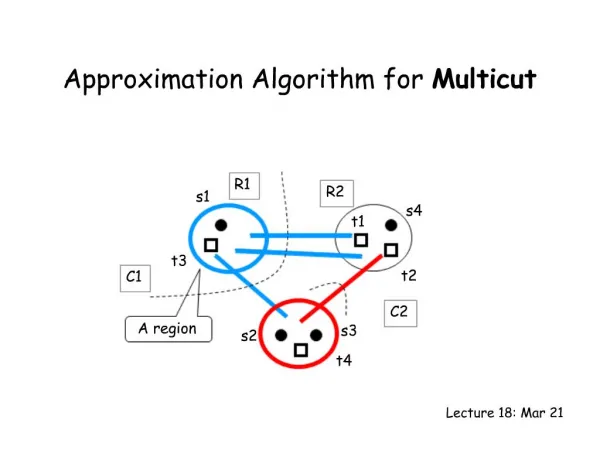
Multicut s3 s1 s2 t4 s4 Goal: separate each si from ti removing the fewest edges t2 t3 t1 Cost = 7 Shuchi Chawla
Sparsest Cut s3 s1 For a set S, “demand” D(S) = no. of pairs separated “capacity” C(S) = no. of edges separated s2 t4 s4 Sparsity = C(S)/D(S) t2 Goal: find a cut that minimizes sparsity t3 t1 Sparsity = 1/1 = 1 Shuchi Chawla
Approximating Multicut & Sparsest Cut Multicut O(log n) approx via LPs [GVY’96] APX-hard [DJPSY’94] Integrality gap of O(log n) for LP & SDP [ACMM’05] Sparsest Cut O(log n) for “uniform” demands [LR’88] O(log n) via LPs [LLR’95, AR’98] O(log n) for uniform demands via SDP [ARV’04] O(log3/4n)[CGR’05], O(log n log log n)[ALN’05] Nothing known! Shuchi Chawla
Our results • Use Khot’s Unique Games Conjecture (UGC) • A certain label cover problem is NP-hard to approximate The following holds for Multicut, Sparsest Cut and Min-2CNF Deletion : • UGC L-hardness for any constant L > 0 • Stronger UGC W(log log n)-hardness Shuchi Chawla
( , , , ) A label-cover game Given: A bipartite graph Set of labels for each vertex Relation on labels for edges To find: A label for each vertex Maximize no. of edges satisfied Value of game = fraction of edges satisfied by best solution “Is value = or value < ?” is NP-hard Shuchi Chawla
( , , , ) Unique Games Conjecture Given: A bipartite graph Set of labels for each vertex Bijection on labels for edges To find: A label for each vertex Maximize no. of edges satisfied Value of game = fraction of edges satisfied by best solution UGC: “Is value > or value < ?” is NP-hard [Khot’02] Shuchi Chawla
The power of UGC • Implies the following hardness results • Vertex-Cover 2 [KR’03] • Max-cut GW = 0.878 [KKMO’04] • Min 2-CNF Deletion • Max-k-cut • 2-Lin-mod-2 . . . UGC: “Is value > or value < ?” is NP-hard [Khot’02] Shuchi Chawla
Conjecture is plausible Conjecture is true (1) 1- (1) conjectured NP-hard [Khot 02] 1/k 1-k-0.1 solvable [Khot 02] L() known NP-hard [FR 04] 1- 1/3 1- (/log n) solvable [Trevisan 05] The plausibility of UGC k : # labels n : # nodes 1 0 Strongest plausible version: 1/, 1/ < min ( k , log n ) Shuchi Chawla
Our results • Use Khot’s Unique Games Conjecture (UGC) • A certain label cover problem is hard to approximate The following holds for Multicut, Sparsest Cut and Min-2CNF Deletion : • UGC W( log 1/(d+) )-hardness L-hardness for any constant L > 0 • Stronger UGC W( log log n )-hardness ( k log n, , 1/log n ) Shuchi Chawla
The key gadget • Cheapest cut – a “dimension cut” cost = 2d-1 • Most expensive cut – “diagonal cut” cost = O(d 2d) • Cheap cuts lean heavily on few dimensions [KKL88]: Suppose: size of cut < x 2d-1 Then, a dimension h such that: fraction of edges cut along h > 2-W(x) Shuchi Chawla
( , , ) Relating cuts to labels Shuchi Chawla
Good Multicut good labeling Suppose that “cross-edges” cannot be cut Each cube must have exactly the same cut! cut < log (1/) 2d-1 per cube -fraction of edges can be satisfied Conversely, a “NO”-instance of UG cut > log (1/) 2d-1 per cube Picking labels for a vertex: # edges cut in dimension h total # edges cut in cube * * Prob[ label1 = h1 & label2 =h2 ] > * * Prob[ label = h ] = 2-2x x2 2-x x > [ If cut < x 2d-1 ] > for x = O(log 1/) Shuchi Chawla
Good labeling good Multicut Constructing a good cut given a label assignment: For every cube, pick the dimension corresponding to the label of the vertex a “YES”-instance of UG cut < 2d per cube What about unsatisfied edges? Remove the corresponding cross-edges Cost of cross-edges = n/m no. of nodes no. of edges in UG Total cost 2d-1 n + m2d-1 n/m O(2d n) = O(2d) per cube Shuchi Chawla
Revisiting the “NO” instance • Cheapest multicut may cut cross-edges • Cannot cut too many cross-edges on average For most cube-pairs, few edges cut Cuts on either side are similar, if not the same • Same analysis as before follows Shuchi Chawla
A recap… “NO”-instance of UG cut > log 1/(+) 2d-1 per cube “YES”-instance of UG cut < 2d per cube UGC: NP-hard to distinguish between “YES” and “NO” instances of UG NP-hard to distinguish between whether cut < 2dn or cut > log 1/(+) 2d-1 n W( log 1/(+) )-hardness for Multicut Shuchi Chawla
A related result… [Khot Vishnoi 05] • Independently obtain ( min (1/, log 1/)1/6 ) hardness based on the same assumption • Use this to develop an “integrality-gap” instance for the Sparsest Cut SDP • A graph with low SDP value and high actual value • Implies that we cannot obtain a better than O(log log n)1/6 approximation using SDPs • Independent of any assumptions! Shuchi Chawla
Open Problems • Improving the hardness • Fourier analysis is tight • Prove/disprove UGC • Reduction based on a general 2-prover system • Improving the integrality gap for sparsest cut • Hardness for uniform sparsest cut, min-bisection … ? Shuchi Chawla