Chapter 13: Color Processing
This chapter delves into the fundamental aspects of color processing, exploring how colors are perceived and represented in various color spaces. It covers the human eye's photoreceptors, the RGB and CIE color spaces, chromaticity diagrams, and the significance of saturation and brightness in determining color. Various color spaces like HSV and YIQ are discussed alongside techniques for color image processing, including noise reduction and contrast enhancement. The intricacies of perceiving and manipulating colors illustrate color's profound role in visual representation.

Chapter 13: Color Processing
E N D
Presentation Transcript
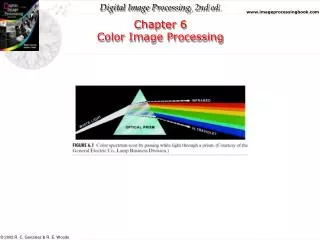
Chapter 13: Color Processing • 。 Color: An important descriptor of the • world • 。 The world is itself colorless • 。 Color is caused by the vision system • responding differently to different • wavelengths of light.
。 Image color depends on: • (1) The color of the incidence light • (2) The color of the scene surface • (3) The nature of the visual sensor
Two kinds of photoreceptors: rods, cones
Rods -- sensitive to light Cones -- sensitive to color Three types of cones:
○ RGB Color Space -- Many colors are made up • of varying amounts of red, green and blue • R, G, B: primary colors, real : color matching functions may be negative
○ CIE XYZ Color Space • CIE (Commission Internationale d’Eclairage): • an organization responsible for color standard X,Y,Z: not real primaries, Y: luminance Their color matching functions are positive everywhere 。 The volume of visible colors in CIE XYZ space is a cone
○ CIE xy Color Space -- A constant brightness section intersects the XYZ space with the plane Since x + y + z = 1, a color can be specified by x and y alone.
。 Chromaticity Diagram • Spectral locus: the • curved boundary • along which colors • of single wavelengths • are viewed • (ii) Neutral point: the • color whose weights • are equal for all • three primaries • (iii) Colors that lie farther away from the • neutral point are more saturated
。RGB Gamut – The colors correspond to • positive matching values
。Secondary colors (primaries of pigments): • Magenta (purple) = R + B = W - G • Cyan = G + B = W - R • Yellow = R + G = W - B • 。Pigments remove color from incident light, • which is reflected from paper • e.g., Red ink absorbs green and blue light; • incident red light passes through the • ink and is reflected from the paper
Hue: varies from red green Saturation: varies from red pink Brightness: varies from black white • ○HSV (Hue, Saturation, Value) Color Space
○ (i) RGBHSV • If R = V, then • If G = V, then • If B = V, then • If H ends up being negative, add 1 • If (R,G,B) = (0,0,0), then (H,S,V) = (0,0,0)
○YIQ Color Space – Used for TV and video • Y : luminance information • I, Q : color information
○ Uniform Color Space • -- The distance in the space is a guide to • color difference • 。 Noticeable difference – the difference when • modifying a color until one can tell it has • changed • 。 Macadam ellipse -- the noticeable difference • of a color forms the boundary of the color in • a color space and can be fitted with an ellipse
The color difference in CIE xy space is poor: (a) the ellipses at the top are larger than those at the bottom (b) the ellipses rotate as they move up
。 CIE u’v’ Color Space – a more uniform • space than the CIE xy color space
○ CIE Lab Color Space • – another substantial uniform space where : the XYZ coordinates of a reference white patch
◎ Pseucoloring • 。 Intensity Slicing
。Transformation • Define colormap functions:
◎ Processing of Color Images • Two methods: • (a) (b)
○ Noise Reduction R G B Apply median filter to Y Apply median filter to R,G,B
○ Contrast Enhancement • Perform on the intensity component • (1) RGB YIQ • (2) Apply histogram equalization to • Y Y’ • (3) Y’IQ R’G’B’
○ Spatial Filtering • Both low- and high- pass filters are better • off applying to the intensity component
○ Edge Detection • Two ways: • (1) Apply edge detection to the intensity • component • (2) Apply edge detection to each RGB • component