
Supply
E N D
Presentation Transcript
Supply and Demand Supply
Supply • Individuals control the factors of production – inputs, or resources, necessary to produce goods. • Individuals supply factors of production to intermediaries or firms.
Supply • The analysis of the supply of produced goods has two parts: • An analysis of the supply of the factors of production to households and firms. • An analysis of why firms transform those factors of production into usable goods and services.
The Law of Supply • There is a direct relationship between price and quantity supplied. • Quantity supplied rises as price rises, other things constant. • Quantity supplied falls as price falls, other things constant.
Law of Supply • Law of Supply • As the price of a product rises, producers will be willing to supply more. • The height of the supply curve at any quantity shows the minimum price necessary to induce producers to supplythat next unit to market. • The height of the supply curve at any quantity also shows the opportunity cost ofproducing the next unitof the good.
The Law of Supply • The law of supply is accounted for by two factors: • When prices rise, firms substitute production of one good for another. • Assuming firms’ costs are constant, a higher price means higher profits.
The Supply Curve • The supply curve is the graphic representation of the law of supply. • The supply curve slopes upward to the right. • The slope tells us that the quantity supplied varies directly – in the same direction – with the price.
S Price (per unit) 0 Quantity supplied (per unit of time) A Sample Supply Curve A PA QA
Shifts in Supply and Movements Along a Supply Curve • Supply refers to a schedule of quantities a seller is willing to sell per unit of time at various prices, other things constant.
Shifts in Supply and Movements Along a Supply Curve • Quantity supplied refers to a specific amount that will be supplied at a specific price.
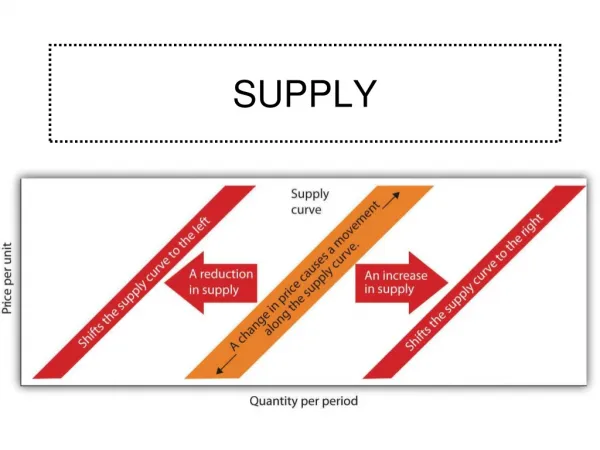
Shifts in Supply and Movements Along a Supply Curve • Changes in price causes changes in quantity supplied represented by a movement along a supply curve.
Shifts in Supply and Movements Along a Supply Curve • A movement along a supply curve – the graphic representation of the effect of a change in price on the quantity supplied.
Shifts in Supply and Movements Along a Supply Curve • If the amount supplied is affected by anything other than a change in price, there will be a shift in supply.
Shifts in Supply and Movements Along a Supply Curve • Shift in supply – the graphic representation of the effect of a change in a factor other than price on supply.
B Change in quantity supplied (a movement along the curve) A A Change in Quantity Supplied S0 Price (per unit) £15 1,250 1,500 Quantity supplied (per unit of time)
S1 Price (per unit) A B Shift in Supply (a shift of the curve) Quantity supplied (per unit of time) A Shift in Supply S0 £15 1,250 1,500
Factors which shift Supply • Other factors besides price affect how much will be supplied: • Prices of inputs used in the production of a good. • Technology. • Suppliers’ expectations. • Taxes and subsidies.
Price of Inputs (Resource Prices) • When costs go up, profits go down, so that the incentive to supply also goes down.
Technology • Advances in technology reduce the number of inputs needed to produce a given supply of goods. • Costs go down, profits go up, leading to increased supply.
Expectations • If suppliers expect prices to rise in the future, they may store today's supply to reap higher profits later.
Number of Suppliers • As more people decide to supply a good the market supply increases (Rightward Shift).
Individual and Market Supply Curves • The market supply curve is derived by horizontally adding the individual supply curves of each supplier.
Price of Related Goods or Services • The opportunity cost of producing and selling any good is the forgone opportunity to produce another good. • If the price of alternate good changes then the opportunity cost of producing changes too! • Example Mc Donalds selling Hamburgers vs. Salads.
Taxes and Subsidies • When taxes go up, costs go up, and profits go down, leading suppliers to reduce output. • When government subsidies go up, costs go down, and profits go up, leading suppliers to increase output.