Feminist Therapy
150 likes | 226 Vues
Explore the evolution of feminist therapy, challenges traditional gender roles, and empowers clients to confront societal oppressions. Learn about techniques, goals, and the impact on gender equality.


Feminist Therapy
E N D
Presentation Transcript
Feminist Therapy Jean Baker Miller, Carolyn Zerbe Enns, Oliva M Espin, Laura S. Brown
Background • Role of social, political and cultural context in individual’s problems • Power: central aspect in human relations • Perspective of psychological theories: White European middle class men • Male gender role as normative • The dominant group tends to consider what is different from them as deviant or “not as good”
Women’s movement of the 1960’s • Reaction against limited female gender roles • Gender socialization affects women’s development and well-being • Cultural conceptions of gender serve as an organizing principle in people’s identity • Traditional therapy: way to maintain the status quo • Need for psychological theories that take into account women’s perspectives and political realities
1970’s and 1980’s • Research on gender bias • Self-in relation models: validate relational and cooperative dimensions of women's experience • Research emphasis on body image, eating disorders, abusive relations, sexual abuse • Expanded focus to: multiple oppressions, multicultural competence, and social justice • Incorporate ideas about gender socialization in working with men -- Men’s Movement
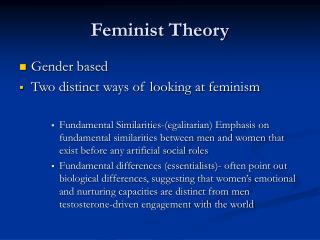
Gender Roles Theory: Traditionalvs. Feminist • Androcentric: male-oriented constructs constitute the norms used to draw conclusions about humans, including female nature • Traditional women’s gender roles and dispositions of connectedness and inter-dependence are devalued & independence and autonomy are exalted • Relational cultural theory- challenges the Androcentric view • Women’s identity and self-concept develop in the context of relationships • Accepts the notion of intrinsic gender differences
Gender Roles Theory: Traditionalvs. Feminist • Gendercentric: There are two separate innate (biologically rooted) paths of development for women and men. • Socio-cultural and power analyses challenges the Gendercentric view (socialization process) • Traditional women’s gender roles and dispositions have been acquired/learned in the context of women’s subservient position • Rejects the notion of intrinsic gender differences
Common Themes in Feminist Philosophies • Gender socialization is central to therapeutic practice for men & women • A socio-political and cultural perspective is essential in understanding people’s problems • Ethnicity, race, sexual orientation, class, age & disabilities • Symptoms may be self-preservation responses to an oppressive environment
Goals of Therapy • Empowerment • Help clients free themselves from the internalized constraints of gender role socialization and oppression • Societal change • Social change to eliminate sexism and other forms of oppression
Techniques and Strategies • Egalitarian counselor-client relationship • Actively engage client in setting the direction, goals, length and procedures of therapy • Therapist Self-disclosure • To decrease power differential • Gender Role Analyses/Intervention • Emphasize societal as opposed to intra-psychic origin of problems • Examine how internalized societal expectations regarding gender roles are related to client’s issues • Internalized homo-phobia, racial devaluation
Techniques and Strategies • Power analysis • Raise awareness of power difference between men and women in society. • Help clients recognize different kinds of power they possess and how they and others exercise power– personal and societal levels • Assertiveness Training
Techniques and Strategies • Bibliotherapy • To help educate clients about societal issues • Increases clients’ expertise and decreases power differential in therapy • Social Action • Encourage clients to actively influence social change regarding women/other oppressed groups • Helps empower clients by making the connection between society and personal problems
Contributions • Brought awareness to the impact of the cultural context and multiple oppressions • Gave validity to women’s perspectives • Sexual conduct in therapeutic relations has been recognized and sanctioned • Strengths in women's qualities of nurturance and cooperation (rather than competition) are recognized • Established as proper focus of therapy to change oppressive conditions rather than just expect clients to adapt to them
Limitations • Feminist therapy does not take a neutral stance regarding gender roles • May put undue pressure on clients to follow a specific direction • Not all clients may be interested in engaging in social action • Over-emphasis on environmental factors may • Neglect exploration of the intra-psychic world • Motivate clients to forsake responsibility for themselves in the face of an unjust world