
Managing Puncturevine in Florida: Identification, Distribution, and Control Methods
E N D
Presentation Transcript
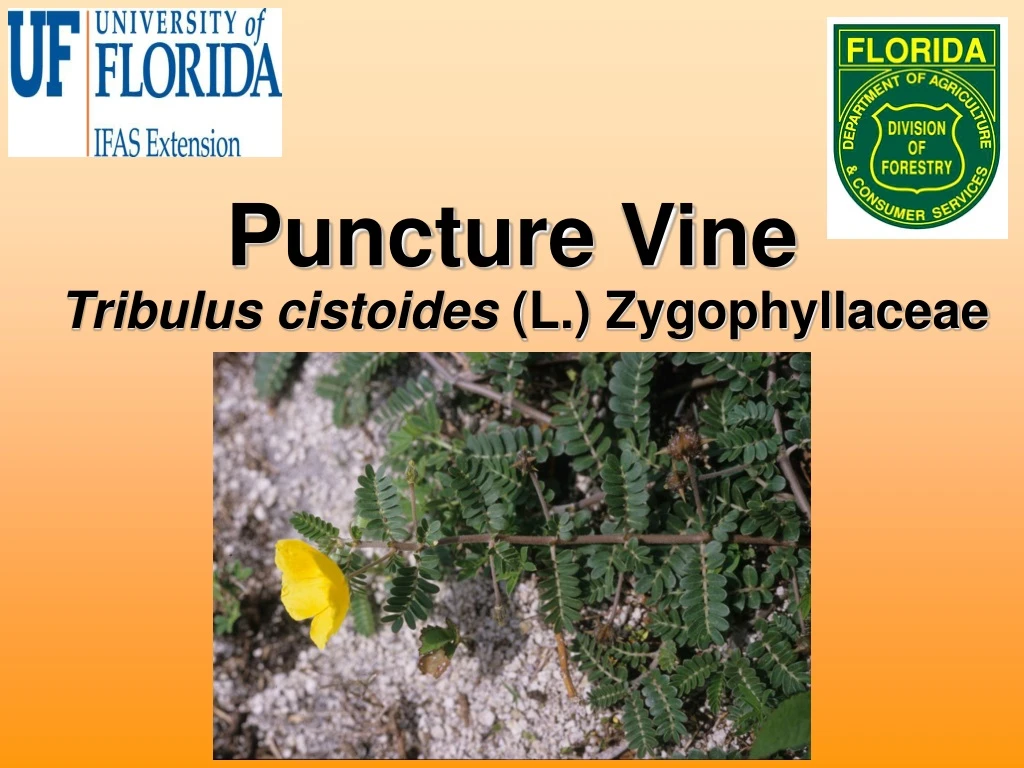
Puncture Vine Tribulus cistoides (L.) Zygophyllaceae
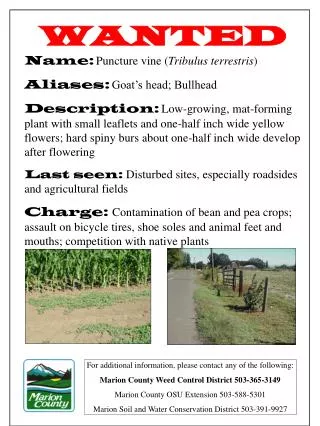
Biology • Native to tropical America • Introduced as an ornamental • Tolerant to salinity and drought • Used for groundcover in coastal areas • Common name from spiny, hard fruits • Medicinal properties – used in treating ailments (headaches, etc.)
Distribution & Impacts • Generally found in southeast Florida • Generally as a direct escape from cultivation • Found on dunes, coastal lands, sandy sites • Category II Invasive Species – FLEPPC • Found in medians, yards and landscapes as a weedy species • Potential harm to humans and animals
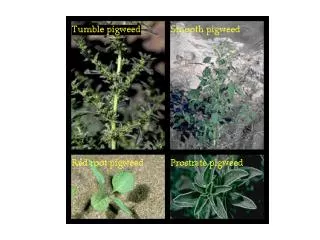
Mature Plant • Creeping, prostrate perennial • Spreads through lateral stem formation
Leaves • Leaves are arranged oppositely • 6 inches long • Pinnately compound with 6 to 8 pairs of elliptic leaflets • Lack terminal leaflet
Flowers and Fruit • Flowers are solitary • Bright yellow, 1.5 inches wide • 5 petals • Fruit are spiny, ½ inch • Spread easily by machinery, humans • Dormant for years
Management Preventative Cultural Mechanical Biological Chemical
Preventative • Limit planting as an ornamental • Remove existing plants before seeds are produced • Avoid mowing, other mechanical operations when plant is fruiting – spread seed to other areas
Cultural • Alternative landscape plants to replace puncturevine • Programs to educate homeowners about the problems associated with this plant and proper identification • Maintain good ground cover and mixture of plant species to reduce establishment
Biological • There are 2 known biological control agents available for puncturevine, but limited distribution
Mechanical • Hand pull plants out of moist soil, wear gloves • Mowing or cutting is ineffective, as the plant is prostrate in growth habit, may actually spread the plant through seed spread
Chemical • Over-the-top applications of glyphosate, dicamba or 2,4-D at 1 to 2% solution plus 0.25% surfactant • Glyphosate is non-selective and will damage other plants • Dicamba and 2,4-D can be used in many turf settings – check label
Useful Links • Floridata Homepage: http://www.floridata.com/main_fr.cfm?state=Welcome&viewsrc=welcome.htm • University of Florida Center for Aquatic and Invasive Plants: http://aquat1.ifas.ufl.edu/welcome.html • The Plant Conservation Alliance's Alien Plant Working Group. Weeds Gone Wild: Alien Plant Invaders of Natural Areas: http://www.nps.gov/plants/alien/index.htm
Useful Links • Pacific Island Ecosystems at Risk (PIER). Plant Threats to Pacific Ecosystems: http://www.hear.org/pier/threats.htm • USDA Natural Resources Conservation Service. Plants Database: http://plants.usda.gov • Forest Management of Miami-Dade County: http://www.miamidade.gov/derm/Plants/plants_puncture_vine.asp • Bureau of Land Management, Oregon /Washington: http://www.or.blm.gov
Literature Cited Langeland, K.A. and K. Craddock Burks. 1998. Identification and Biology of Non-Native Plants in Florida's Natural Areas. IFAS Publication SP 257. University of Florida, Gainesville. 165 pp