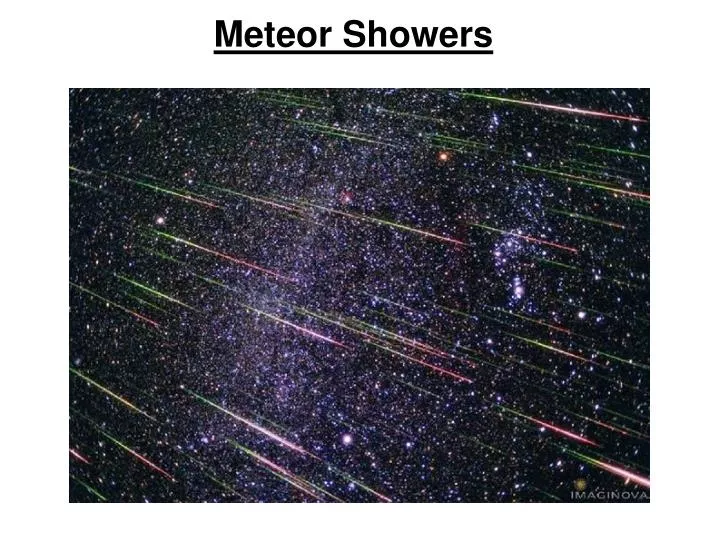

Meteor Showers
E N D
Presentation Transcript
What's the Source of Meteor Showers? Comets ...
How It Works ... Meteor Shower Movie Comet Movie
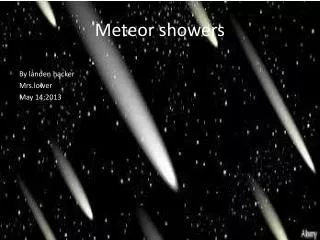
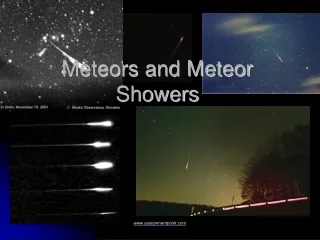
Meteors and Meteorites: • When bits of dust from asteroids and comets (meteoroids) hit Earth's atmosphere, they burn up brightly. • If they burn up completely, they are meteors. • If remnants land on the Earth, they are meteorites • Where? in thermosphere, 80-120 km high • How Big? small pebble down to grain of sand, < 1-2 grams • How fast? 11-72 km/s! • How many? quite variable: depends on a lot of factors ...
Fireballs! Fireball Movie fireball_animated.gif
Major Meteor Showers: • QUADRANTIDS: Jan 3 (Jan 1-5), up to 100/hr • LYRIDS: April 22 (April 16-25), 10-20/hr • ETA AQUARIDS: May 6 (Apr 18-May 28), ~20/hr • SOUTH DELTA AQUARIDS: Jul 29, up to 20/hr • PERSEIDS: Aug 12 (from 10pm), tens/hr **DARK** • ORIONIDS: Oct 21 (Oct 20-22), 20-25/hr **SOME MOON** • LEONIDS: Nov 17 (Nov 14-21), 5-15/hr ?? **SOME MOON* • GEMINIDS: Dec 14 (Dec 7-17), ~35/hr **FAIRLY DARK**
The Perseids Comet Swift-Tuttle 1862, 1992, 2126
How to Observe Meteor Showers • Look online or in astronomy magazines (e.g. Sky & Telescope, SkyNews) for dates, sky charts, etc • Find where the shower radiant is • Find a dark place where you can see the whole sky. Try to avoid the Moon. Dress warmly. • Give yourself time for your eyes to get dark-adapted • You don't need binoculars or telescopes-- just your eyes! • Sit in a chair or lie on the ground. Look about 30 degrees away from the shower radiant • You'll see more meteors the later you stay up-- especially after midnight
Some WWW Pages http://spaceweather3.com/ http://skytour.homestead.com/met2006.html http://www.space.com/spacewatch/060804_night_sky.html http://www.amsmeteors.org/ http://www.amsmeteors.org/faqm.html http://comets.amsmeteors.org/ http://csep10.phys.utk.edu/astr161/lect/meteors/showers.html
Monitoring of Near-Earth Objects (NEOs) • NASA estimates there are 1100-1200 NEOs 1km or larger in size, with 1 in 500,000 chance of impact with Earth in next 100 yr • Similarly, estimates of ~500,000 NEOs with diameters between 50-100m; still large enough to cause considerable damage. 1 chance in 1000 of impact with Earth in next 100 yrs • Lots of NEO monitoring going on now, using small 1-2 m telescopes (e.g. Spacewatch) • But what could we do if we found a big one on a collision course?? Deep Impact will give some information ...