Mesopotamian Civilization: The Cradle of Civilization
330 likes | 441 Vues
Discover the profound impact of Mesopotamian civilization on human society, from the invention of writing to the intricate religious beliefs and social structure. Learn about the Code of Hammurabi and the sophistication of Sumerian culture.


Mesopotamian Civilization: The Cradle of Civilization
E N D
Presentation Transcript
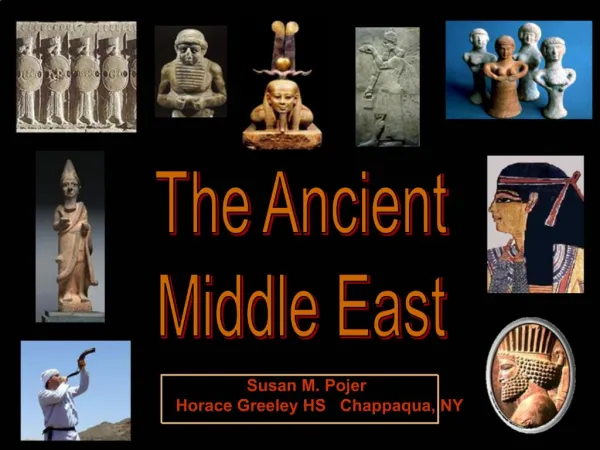
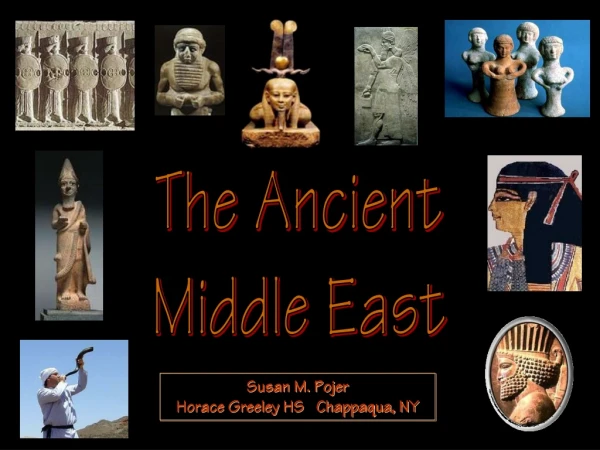
The Ancient Middle East
Early Civilizations • The Neolithic Period • From perhaps 400,000 to 7,000 B.C.E., early human beings survived as hunter gatherers in extended family units, a period known as the Paleolithic, or “Old Stone Age.” • At the start of the Neolithic period, around 7,000 B.C.E., a transformation began: some hunter-gatherer societies began to rely chiefly on agriculture for their subsistence. • Neolithic peoples contributed a great deal to the development of human society, including systematic agriculture, writing, sedentary living, and improved tools and weapons. • Stonehenge and other stone circles scattered throughout Great Britain, Ireland, and Brittany were built by Neolithic societies that must have been prosperous, well organized, and centrally led.
1. Mesopotamia: "Land Between the Two Rivers"
Indo-European Migrations: 4m-2m BCE The Middle East: “The Crossroads of Three Continents”
The Ancient Fertile Crescent Area The Middle East: “The Cradle of Civilization”
Mesopotamian Civilization • Invention of Writing and Intellectual Advancements • Writing appears to have begun at Sumer sometime around the ninth millennium B.C.E. • The Sumerian pictographic form evolved by the fourth millennium into cuneiform (“wedge-shaped”) writing. • The signs in the cuneiform system later became ideograms and evolved into an intricate system of communication. • The writing system was so complicated that only professional scribes mastered it. • Scribal schools flourished throughout Sumer. • Scribal schools were centers of culture and learning. • Mesopotamians made great strides in mathematics, medicine, and religion.
Sumerian Religion - Polytheistic Enki Innana Anthropomorphic Gods
Religion and Society • Mesopotamian religion was polytheistic; gods and goddesses existed to represent almost everything in the cosmos. • The gods had many human attributes. • The Mesopotamians created myths to explain the origins of the universe and of mankind.
The Sumerians produced the first epic poem, The Epic of Gilgamesh. • The arid and harsh environment of Sumer fostered a religion based on placating a pantheon of harsh and capricious gods and goddesses. • Shrines built in the center of Sumerian cities were focal points of Sumerian life and religion.
Sumerian society was organized into four classes of people: nobles, free clients of the nobility, commoners, and slaves. • The king and lesser nobility had huge land holdings. • Clients were free people who were dependent on the nobility. • Commoners were free and were independent of the nobility. • The Sumerian slave population included foreigners, prisoners of war, criminals, and debtors.
Mesopotamian Trade “The Cuneiform World”
Sumerian Scribes “Tablet House”
Ziggurat at Ur • Temple • “Mountain of the Gods”
The Triumph of Babylon • Unification • The Babylonians united Mesopotamia politically and culturally. • Babylon’s best-known king, Hammurabi (ca 1792−1750 B.C.E.), forged a vibrant Sumero-Babylonian culture through conquest and assimilation.
Life Under Hammurabi • Hammurabi also created one of the world’s earliest comprehensive law codes, which today provides much useful information on daily life in ancient Mesopotamia. • The Code of Hammurabi had two notable features: it included different laws for people of different social status, and it was based on the idea that the punishment should fit the crime. • Individuals brought their own complaints before the courts. • The Code dealt extensively with business practices, agricultural issues, and family life.
Egypt, the Land of the Pharaohs (3100−1200 B.C.E.) • The Nile River • Egyptian society revolved around the life-giving waters of the Nile River. • The regularity of the Nile’s floods and the fertility of its mud made agriculture productive and dependable. • The Nile was Egypt’s primary highway and communication conduit.